
Understanding Enterprise Data Migration and Modernization
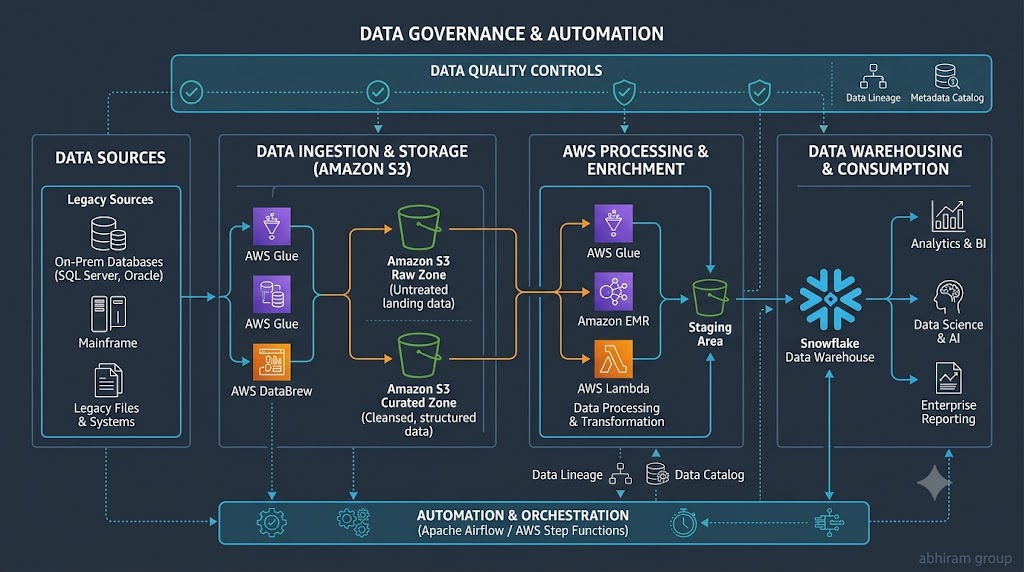
Organizations collect and process data through many applications and systems. Over time, these systems become part of daily business operations. Some manage customer information, others handle transactions, payments, inventory, employee records or business activities.
In many enterprises, these systems were developed at different times using different technologies. An organization may use Oracle for transaction processing, MySQL for operational applications, MongoDB for semi-structured information, Salesforce for customer management and external APIs for exchanging information with business partners. It may also receive Excel files, CSV files and application logs on a daily, weekly or monthly basis.
Each system may work correctly on its own. The difficulty begins when information from these systems needs to be combined.
For example, a customer record may exist in one application, the customer's transactions in another and the related payment information in a third. The business expects a complete view, but the data may use different identifiers, formats and update schedules.
As the number of applications grows, maintaining these integrations becomes more difficult. Changes to one system can affect several downstream processes. A failed data transfer may delay reporting, and an incorrect transformation can produce misleading business results.
Why Organizations Modernize Their Data Platforms
Legacy systems are not necessarily unreliable or outdated simply because they have been running for many years. In fact, some of them support critical business processes and contain valuable historical information.
The challenge is that business requirements continue to change.
Organizations need to process increasing data volumes, integrate new applications, provide information to different teams and support reporting without waiting for lengthy manual data preparation.
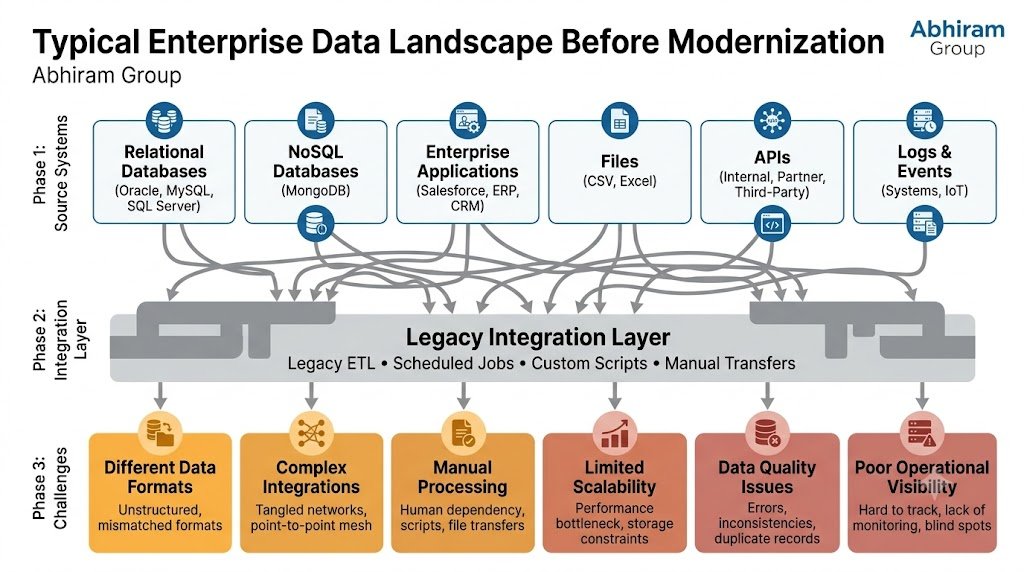
In some environments, data processing depends on scheduled jobs that run overnight. If one job fails, the next job cannot start. Teams may have to investigate the failure, correct the data and restart processing manually.
Other organizations face difficulties when integrating new cloud applications with existing on-premises databases. Network restrictions, incompatible data formats, source-system limitations and different security requirements can make these integrations complicated.
Modernization provides an opportunity to review how data is collected, stored, transformed and shared. The objective is to build a data platform that can support existing business operations while making future changes easier to manage.
However, moving to a cloud platform does not automatically resolve existing data-quality problems. If incorrect data, undocumented rules or unreliable processing logic are migrated without proper assessment, the same problems can continue in the new environment.
Understanding the Difference Between Data Migration and Data Modernization
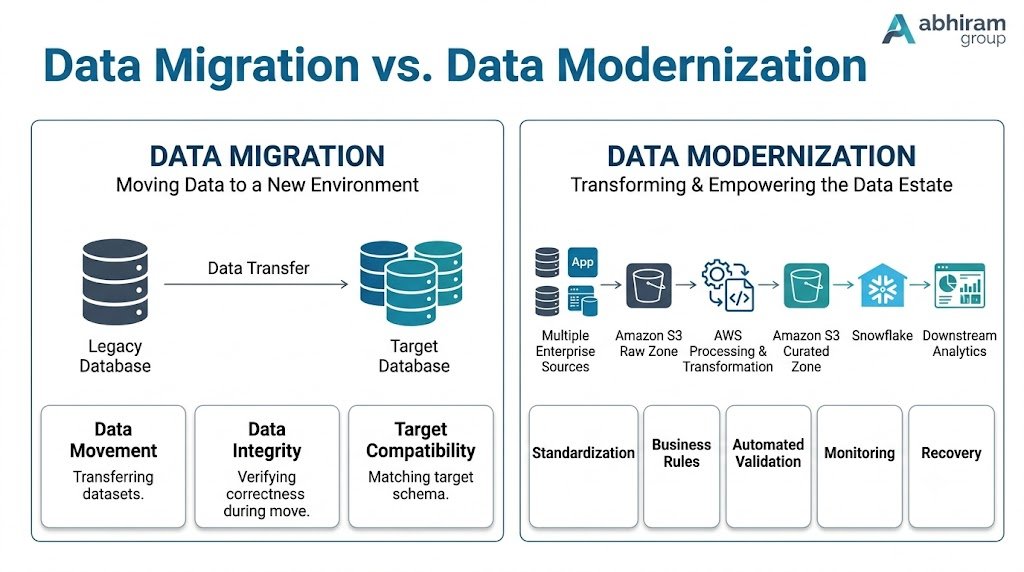
Data migration is the process of moving data from one system, storage location or platform to another.
For example, an organization may move historical records from an on-premises Oracle database to a cloud data warehouse. The migration must preserve the required information and relationships while ensuring that the target system contains the correct data.
Data modernization covers a wider scope.
During modernization, an organization may redesign its data pipelines, replace manual processing, standardize data formats, improve integration between applications, introduce automated validation and create new data models for reporting and analytics.
Consider an existing process that extracts information from several databases, prepares intermediate files and loads the results into a reporting database.
A migration project may reproduce this process on a cloud platform with limited changes.
A modernization project may instead redesign the process to ingest data into Amazon S3, apply transformations using AWS services, organize the outputs into curated datasets and load the final information into Snowflake for downstream consumption.
The second approach introduces opportunities to improve scalability, monitoring, recovery and data quality. It also requires more careful testing because the processing logic and architecture may change.
In either approach, the business must be able to trust the information produced by the new platform.
Organizations generally select an approach based on the condition of their existing systems, business priorities, available resources and tolerance for disruption.
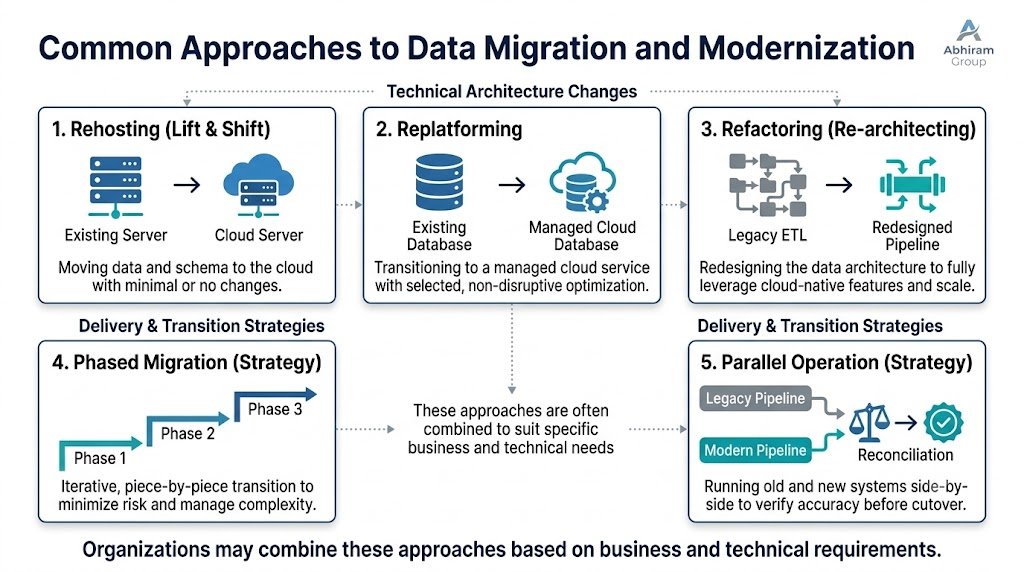
Common Approaches to Migration and Modernization
- Rehosting: Moving an existing application or workload to new infrastructure with minimal changes. This may reduce infrastructure dependencies but does not necessarily improve the underlying data-processing logic.
- Replatforming: Moving to a different managed platform while making selected changes to improve compatibility, operations or performance.
- Refactoring: Redesigning existing processing logic, pipelines or application components to take advantage of the new architecture.
- Phased migration: Moving datasets or business processes in manageable stages rather than migrating everything at once.
- Parallel operation: Running legacy and modernized processes together for a defined period so teams can compare results before retiring the old process.
These approaches are not mutually exclusive. A large enterprise may rehost one application, refactor another pipeline and migrate historical data in phases.
The important decision is understanding what will change, what must remain consistent and how the organization will prove that the new process meets business requirements.
Understanding How Data Moves During Migration
Before designing the new platform, engineering teams must understand how information is currently created, updated and transferred between systems.
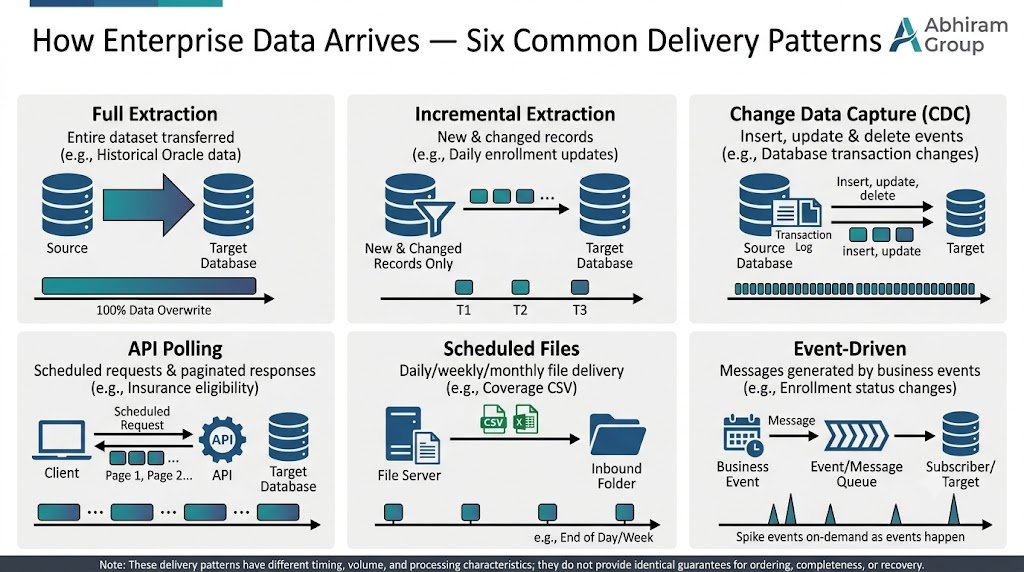
Data may arrive in several ways.
Some systems provide a complete extract containing all available records. Others support incremental extraction, where only records changed since a previous successful processing point are retrieved. Databases may also provide Change Data Capture (CDC), which records inserts, updates and deletes through a supported change mechanism.
External applications may provide data through APIs. Business partners may send files at scheduled intervals. Operational systems may generate event messages or application logs.
These sources do not always deliver information at the same time or in the same order.
For example, a transaction may be created in one system, updated in another and reflected in a reporting source several minutes later. If a pipeline extracts the related datasets at different times, the records may temporarily appear inconsistent.
Engineering teams must define how these timing differences are handled. They also need to understand which source is authoritative for each business field, how historical changes are represented and what should happen when an expected record is missing.
These decisions directly affect the extraction design, transformation rules, reconciliation approach and downstream data quality.
The Challenges That Are Often Discovered During Migration
One of the first challenges is incomplete documentation.
A legacy application may have been running for several years. The original development team may no longer be available, and existing mapping documents may not reflect the current processing logic.
Some transformation rules may be implemented inside stored procedures, scheduled scripts or application code. Others may exist only in reports or manual operational procedures.
Data quality is another concern.
The same business entity may be represented differently across systems. One application may store a customer identifier as a number, while another stores it as text. Dates may use different formats. Mandatory fields in one system may be optional in another.
Historical data can introduce additional complications. Records may contain outdated reference values, incomplete information or inconsistent relationships that were accepted by older applications.
The migration itself also creates operational risks. A source connection may fail during extraction. A large file may arrive late. A transformation job may stop after processing part of a batch. An incremental load may unexpectedly contain several times the normal volume.
These situations must be considered during solution design, not only after they occur in production.
A reliable modernization approach should make it possible to identify where processing stopped, determine which records were affected and resume safely without losing or unintentionally duplicating data.
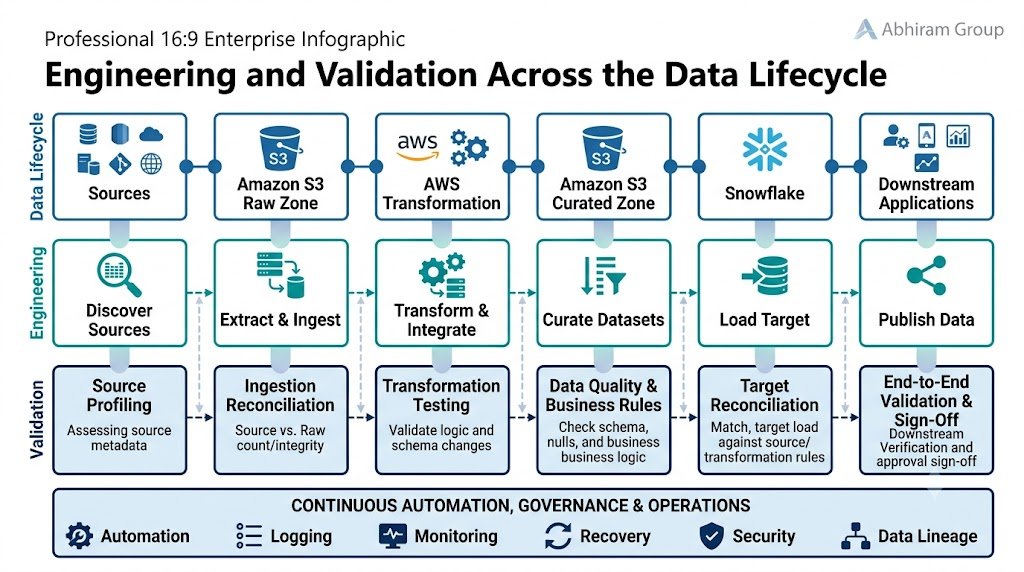
Why Engineering and Validation Must Work Together
Data engineering teams are responsible for building the pipelines that extract, integrate, transform and load information into the target platform.
Validation teams are responsible for independently verifying that the processing produces the expected results.
These responsibilities are closely connected.
For example, engineering may design an incremental load that extracts records based on the last updated timestamp. The validation team must verify whether that logic captures every required change, including records updated at the extraction boundary, late-arriving records and multiple updates to the same business key.
Similarly, engineering may introduce deduplication during transformation. Validation must confirm that duplicate records are identified using the correct business rules and that valid records are not accidentally removed.
A pipeline can complete successfully from a technical perspective while producing incorrect business information. The job may report a successful status, every file may have been processed and the target table may contain records, but an incorrect join or filter can still affect the final output.
This is why validation cannot be limited to checking whether jobs completed or whether source and target record counts match.
Engineering and QA teams should agree on the expected data behavior, transformation rules, reconciliation methods, error handling and acceptance criteria before production processing begins.
The same understanding should guide automated testing, regression, monitoring and production support.
What Does a Successful Modernization Look Like?
A successful migration is not determined only by whether the new platform is available or whether the data has been loaded.
The organization must verify that the required records have been migrated, business rules are producing the correct results and downstream applications can use the information as expected.
The platform should also support reliable day-to-day processing.
If an incremental job fails, the team should be able to identify the affected batch and restart processing without introducing duplicate records. If data volumes increase unexpectedly, the system should provide enough information to investigate the cause and manage the additional workload.
Changes to source schemas, transformation rules or target structures should trigger appropriate testing before they affect business users.
Engineering teams need clear operational logs and monitoring. Validation teams need repeatable reconciliation checks and evidence of test results. Business owners need confidence that critical information remains accurate and available.
Modernization is successful when the new platform can be operated, maintained, validated and changed without placing the business at unnecessary risk.
Before migration begins, the project should define how success will be measured. This includes the required data completeness, accuracy of business rules, acceptable processing delays, recovery expectations and readiness of downstream applications.
Not every dataset will have the same acceptance criteria. Critical financial or customer records may require stricter reconciliation than datasets used for less time-sensitive reporting.
The agreed criteria should be documented and reviewed by engineering, QA and business owners. Final sign-off should be based on evidence that these requirements have been met, with any approved exceptions clearly recorded.
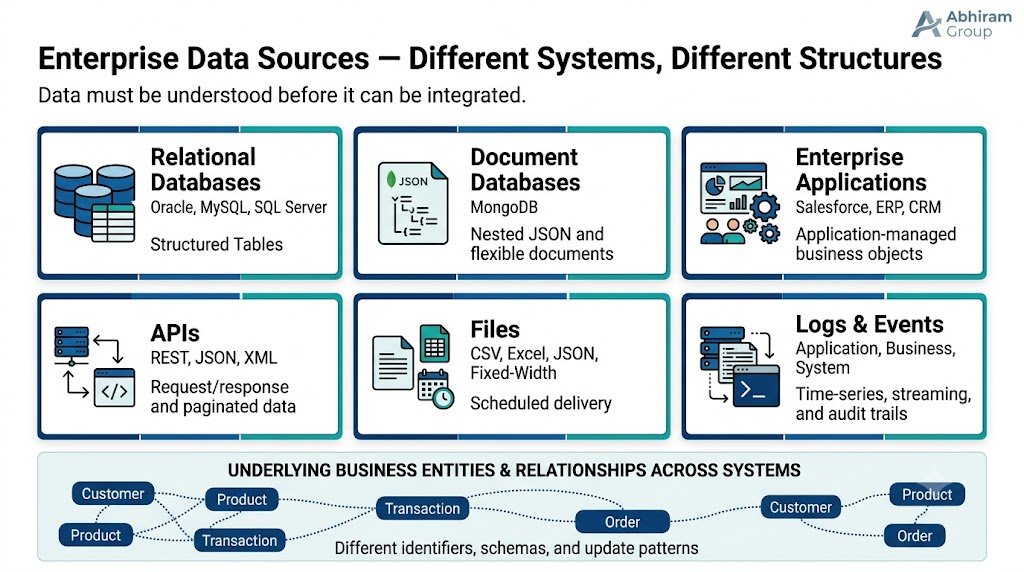
Understanding Enterprise Data Sources and Their Integration Challenges
Before building a new data pipeline, the engineering team needs to understand where the data is coming from and how it is being used.
In most enterprises, information is not stored in a single database. Different applications manage different parts of the business. Some systems process transactions, others maintain customer or product information, and external applications provide additional data through APIs or scheduled files.
These systems may use different database technologies, data structures, identifiers and processing schedules.
For example, an organization may maintain customer records in Oracle, product information in MySQL, customer interactions in MongoDB and account details in Salesforce. Payment information may arrive through APIs, while business partners send CSV files at scheduled intervals.
The challenge is not simply connecting to these systems. We also need to understand what each dataset represents, how frequently it changes, which records are related and how the information is used by downstream applications.
A successful migration begins with understanding these relationships.
Without this assessment, teams may move data to the cloud but later discover that important fields, transformation rules, historical changes or source dependencies were missed.
Relational Databases: Structured but Not Always Consistent
Relational databases such as Oracle, MySQL and SQL Server are commonly used to store business information in tables.
Each table contains columns, records and relationships. Primary keys identify records, while foreign keys may connect information across tables.
Although these databases follow a structured model, that does not mean data can be moved between them without additional work.
The same information may be stored using different column names, data types or business rules. One system may store a customer identifier as a number, while another stores it as text. Dates may include time-zone information in one system but not another.
Even when two databases contain similar information, their records may not represent the same business event or point in time.
Practical example: Patient enrollment
Consider an enrollment application using Oracle.
The application maintains separate tables for patient information, enrollment details and enrollment status history.
A patient may have one record in the patient table but multiple records in the enrollment history table because the enrollment status changed over time.
If the migration team extracts only the latest enrollment record without understanding the business requirement, important historical information may be lost.
Engineering must identify the correct relationships and determine whether the target requires current status, complete history or both.
Validation must verify that the required patient records, enrollment relationships and historical status changes are preserved.
Simply comparing table counts would not be sufficient because the source and target may use different data models.
NoSQL and Document Databases: Handling Flexible Data Structures
Document databases such as MongoDB store information in documents rather than traditional relational tables.
A document may contain simple fields, nested objects and arrays. Different documents within the same collection may also contain different fields.
This flexibility is useful for applications, but it introduces challenges when data must be transformed into structured datasets.
For example, one document may contain a single contact number, while another contains several contact numbers with different types. Some documents may not contain a contact number at all.
The engineering team must decide how nested fields and arrays will be represented in the target. Depending on the business requirement, the data may be flattened into columns, separated into related tables or retained in a semi-structured format.
Practical example: Patient engagement
A patient engagement application may store communication history in MongoDB.
One patient document may contain multiple events such as welcome messages, appointment reminders and program follow-ups.
If the target reporting model requires one row per communication event, the pipeline must expand the event array into individual records.
Validation must confirm that every required event is captured, that each event remains linked to the correct patient and that the original event timestamps are preserved.
A common issue occurs when an array is flattened incorrectly. A single patient record may produce several target rows, or events may be lost when optional fields are missing.
For this reason, comparing the number of source documents with the number of target event records is not a valid reconciliation method unless the transformation rules are considered.
Enterprise Applications and CRM Systems
Enterprise applications such as Salesforce, ERP and CRM platforms store information according to their application-specific business models.
Unlike a database connection where teams may have direct access to tables, these platforms often expose information through supported APIs, export services or approved integration tools.
The available fields and records may depend on application permissions, object relationships, API capabilities and extraction limits.
Some applications also contain system-managed fields, calculated values or historical tracking information that must be handled carefully during migration.
Practical example: HCP information
A healthcare organization may use Salesforce to maintain Healthcare Professional (HCP) information, account affiliations and interactions.
An HCP may be associated with more than one hospital, clinic or healthcare organization.
During migration, engineering must extract the HCP records and the related affiliation information using the supported integration method.
Validation must verify that the correct HCP records are present, that affiliations remain connected to the appropriate organizations and that active or inactive relationships are handled according to the business rules.
The team must also consider whether deleted records, changed relationships and historical updates are available through the selected extraction method.
A successful API response does not automatically confirm that all required business information has been retrieved.
APIs and External Integrations
Many enterprise applications exchange information through APIs.
APIs allow systems to request or receive information without directly accessing the underlying database.
However, API-based extraction introduces its own challenges.
An API may return only a limited number of records in each response. The integration must retrieve the remaining pages until the complete dataset has been collected.
Some APIs impose rate limits, require tokens that expire or return temporary errors. Others provide records based on date filters or change timestamps.
The pipeline must handle these conditions without skipping records or creating unnecessary duplicates.
Practical example: Insurance eligibility
Assume an insurance integration provides eligibility information through an API.
A request may return 500 records per page. If 2,300 records are available, the extraction process must retrieve all five pages, including the final partial page.
If the fourth request fails, the pipeline should retry according to the API's documented behavior or resume from a safe continuation point.
Validation must verify the expected extraction scope, the completeness of retrieved pages and the uniqueness of business records or events.
If the API returns an empty response, the team must distinguish between a valid no-data result and a failed or incomplete request.
The engineering design should also account for changes occurring while pages are being retrieved. Depending on the API, a stable snapshot, cursor or carefully controlled extraction window may be needed to avoid missing or repeating records.
The team must also verify that the API account has permission to retrieve the required records and fields. A successful response may contain only the information visible to that account.
Filters, inactive-record handling and default query behavior should be reviewed during source assessment. Where the API provides reliable totals or control information, these should be used to help verify extraction completeness.
Files and Scheduled Data Feeds
Not all enterprise information is available through databases or APIs.
Many organizations continue to exchange data through CSV files, Excel workbooks, fixed-width files, JSON files and other agreed formats.
These files may arrive daily, weekly, monthly or whenever a business event occurs.
File-based integration appears simple, but several practical problems can affect processing.
A file may arrive late, contain fewer records than expected, use a different column order or include an unexpected data format.
Sometimes a business partner sends a corrected file using the same filename. If the pipeline identifies files only by name, it may ignore the correction or process the same data twice.
### Practical example: Insurance and enrollment files
A healthcare partner may send a daily CSV file containing enrollment or coverage updates.
The agreed format includes patient reference number, enrollment ID, coverage status and effective date.
One day, the partner adds an additional column without informing the receiving team. Another day, the file contains an invalid date value.
Engineering must define how files are received, identified, validated, stored and processed. The process should not assume that every file follows the expected structure.
Validation must verify file completeness, headers, delimiters, data types, mandatory fields, record counts and duplicate delivery.
Where possible, file manifests, control totals or completion signals should be used to distinguish a complete delivery from a partially uploaded file.
Incorrect records should be handled through an approved rejection or quarantine process rather than silently discarded.
A reliable file-ingestion process should maintain a record of each delivery. Depending on the integration agreement, this may include the filename, delivery identifier, received timestamp, file size, checksum and storage version.
For example, if a partner sends a corrected enrollment file with the same filename, the receiving system must distinguish the new delivery from the original. It should also determine whether the correction replaces the earlier data or represents an additional update.
These rules help prevent accidental reprocessing, missed corrections and unexplained differences during reconciliation.
Application Logs and Event Data
Application logs and business events can provide valuable information during migration and modernization.
However, it is important to understand that not every log contains complete business data.
Application logs may record requests, responses, processing failures and execution details. Business event streams may record meaningful changes such as an enrollment submission, status update or completed transaction.
System logs may provide information about service availability, authentication failures and processing performance.
These different types of information serve different purposes.
Practical example: Enrollment status changes
A patient enrollment application may publish events when an enrollment is created, approved, rejected or updated.
These events can help downstream systems understand how the enrollment status changes over time.
If an event is delivered twice, the pipeline must prevent unintended duplicate processing.
If events arrive out of order, the system must apply the correct ordering or version rules before updating the target.
Validation must verify event identifiers, timestamps, ordering, duplicate handling and the expected final business state.
Logs can also help investigate why a record did not reach the target. However, they should not be treated as a complete replacement for authoritative source records unless the system has explicitly been designed and verified to provide that guarantee.
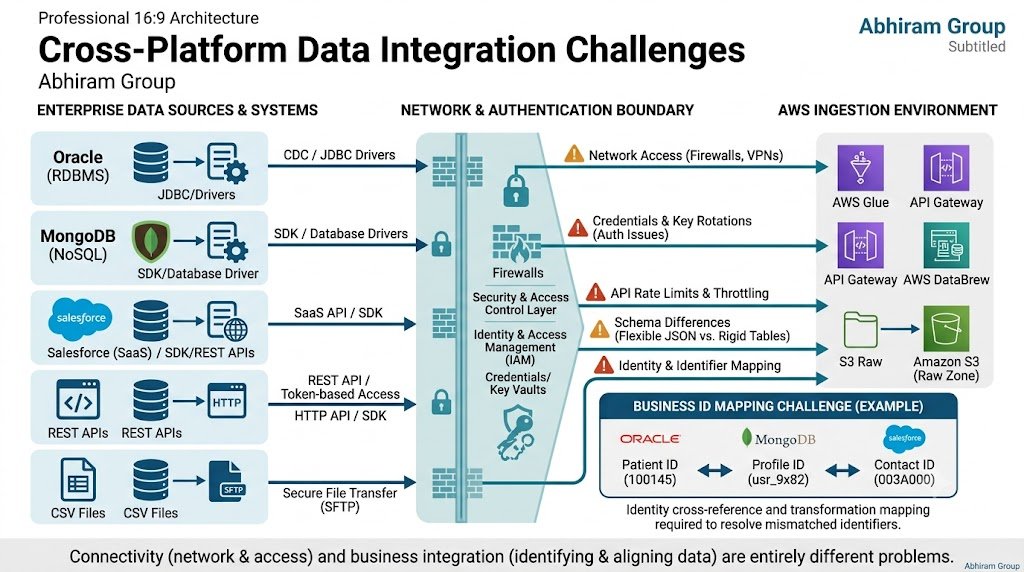
Challenges of Connecting Different Systems
One of the most difficult parts of enterprise integration is connecting systems that were not originally designed to work together.
A source database may be hosted inside a private corporate network, while the modernization platform runs in AWS. Direct connectivity may not be permitted.
Some source systems support standard database connections. Others require REST APIs, approved export tools or secure file transfers.
The engineering team must select the appropriate integration method for each source rather than assuming that a single connector will work everywhere.
Network access, firewall rules, DNS resolution, authentication, certificates, service accounts and data-access permissions all need to be considered.
Connection reliability is only one part of the problem.
The source and target may use different data types, character encodings, time zones and business identifiers. A field that appears similar in two systems may have a different business meaning.
Practical example: Patient information across systems
Suppose patient enrollment data is stored in Oracle, communication history in MongoDB and support-program information in Salesforce.
The Oracle system uses an internal patient ID. MongoDB stores an application-specific profile ID, while Salesforce uses its own contact identifier.
Even after all three connections work successfully, engineering cannot simply join the datasets using these unrelated IDs.
The team must identify an approved cross-reference or identity-matching process.
Validation must confirm that records are linked to the correct patient and that unrelated records are not combined.
Source Discovery and Assessment
Source discovery is one of the most important activities before starting a migration.
The objective is to understand the existing data, its business meaning and the technical conditions under which it can be extracted.
The team should begin by identifying the source applications, databases, interfaces, datasets and business owners.
For relational databases, this includes reviewing schemas, tables, columns, primary keys, foreign keys, indexes and relevant stored procedures.
For document databases, the team needs to inspect document structures, nested fields, arrays and variations between records.
For APIs, the assessment should cover endpoints, authentication, pagination, filtering, rate limits, available change indicators and error responses.
For file-based sources, the team should collect sample files, expected delivery schedules, layouts, control files and file-naming conventions.
The assessment must also identify how data is used.
A field may be required by a downstream report even if it is rarely used in the source application. A stored procedure may apply a business filter that is not mentioned in any mapping document.
Source discovery should therefore involve engineering, QA and business teams.
Engineering identifies how the data can be extracted. QA identifies the conditions that must be tested. Business owners confirm the meaning and expected use of important information.
The result should be a documented source inventory and an initial understanding of the data relationships, quality issues and migration risks.
The assessment should also identify how the source behaves while data is being extracted.
For example, if a large table takes two hours to extract, records may be inserted, updated or deleted during that period. Without a consistent extraction point or an approved synchronization method, the resulting dataset may not represent a reliable source state.
The team should determine whether the source supports snapshot-based extraction, transaction-consistent reads, change tracking or another suitable approach. This becomes particularly important when the initial historical load must be combined with ongoing incremental changes.
A source assessment should capture more than the database name and connection details.
For each important dataset, the team should record the following information.
What Teams Must Capture Before Migration
- Source identification: Application name, database or API, environment, business owner and technical contact.
- Dataset structure: Tables, collections, objects, fields, data types and relationships.
- Business meaning: What the data represents, which system owns it and how it is used.
- Keys and identifiers: Primary keys, business keys, cross-reference identifiers and uniqueness rules.
- Data volume: Historical record counts, expected daily changes, file sizes and peak volumes.
- Extraction method: Full load, incremental query, CDC, API, event stream or file transfer.
- Change tracking: Update timestamps, sequence numbers, CDC positions, delete indicators and retention limits.
- Processing frequency: Real-time, scheduled batch, daily, weekly, monthly or event-driven.
- Dependencies: Other datasets, reference data, upstream processes and downstream consumers.
- Data quality: Nulls, duplicates, invalid values, inconsistent formats and missing relationships.
- Security: Sensitive fields, encryption requirements, access permissions and approved handling methods.
- Operational behavior: Expected delivery time, failure handling, retry limits, source maintenance windows and support contacts.
- Historical requirements: Retention period, deleted records, audit history and backfill requirements.
- Validation baseline: Source control totals, approved business rules, reconciliation keys and known exceptions.
This inventory becomes a working reference for pipeline design, mapping preparation, testing and production support.
It should be updated when the team discovers new source behavior or undocumented dependencies.
What Happens When Mapping or Requirement Documents Are Missing?
In many modernization projects, the existing documentation is incomplete or outdated.
A mapping document may describe the original transformation logic, but the production implementation may have changed several times.
Sometimes there is no mapping document at all.
In this situation, the team should not begin by assuming that matching column names represent matching business rules.
The first step is to examine the available evidence.
Engineering can review existing SQL queries, stored procedures, ETL jobs, application code, schemas, historical files and downstream reports.
QA can profile source and target data, identify repeated patterns, examine exceptions and compare the behavior of existing processes.
Business owners should review the findings and confirm which rules are still valid.
Practical example: Enrollment status mapping
Assume the legacy enrollment system contains several status values:
NEW
PENDING
APPROVED
REJECTED
CLOSED
The existing reporting database contains only ACTIVE and INACTIVE.
Without documentation, the team cannot safely assume how each source status should be converted.
For example, PENDING may be treated differently depending on whether the reporting dataset represents enrollment progress or program eligibility.
The team should inspect the existing transformation logic and reports, document the possible mappings and obtain business approval.
Until the rules are confirmed, they should be marked as unresolved rather than silently implemented.
AI tools may help identify candidate mappings or explain legacy SQL, but their suggestions must be checked against source behavior and approved business requirements.
The objective is not simply to reproduce every legacy rule. It is to establish which rules are correct and required for the modernized platform.
Understanding Full Loads, Incremental Loads and Change Data Capture
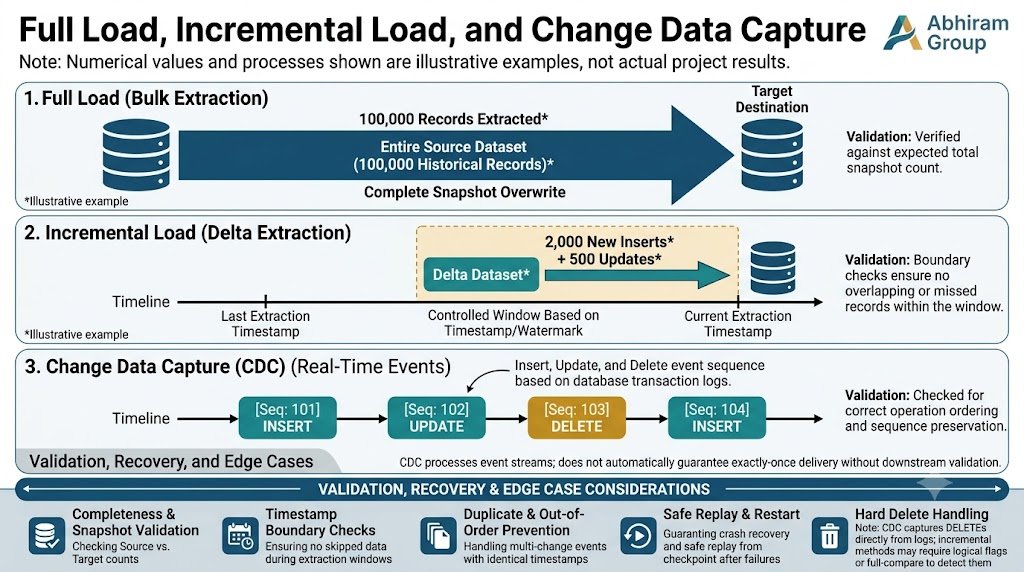
Not every dataset should be extracted using the same method.
The choice depends on source capabilities, data volume, business requirements and how changes are recorded.
Full load
A full load extracts the complete required dataset.
It is commonly used during initial migration, historical backfills or when the source does not provide a reliable method for identifying changes.
For example, an organization may need to migrate several years of historical enrollment records before beginning daily incremental processing.
The team must establish the extraction scope, source consistency point and expected control totals.
Incremental load
An incremental load retrieves records that changed after a defined processing point.
This may use an update timestamp, sequence number or another approved change indicator.
For example, a daily enrollment pipeline may retrieve records updated since the previous successful extraction.
Care is required around extraction boundaries. If multiple records have the same update timestamp, a simple greater-than comparison can miss records unless the cursor design accounts for them.
Incremental extraction also needs a way to handle deletes. A last-updated timestamp alone may not capture hard-deleted records.
Change Data Capture
CDC identifies changes made to source data, often using database transaction logs or another supported change mechanism.
Depending on the source and connector, CDC can provide inserts, updates and deletes, along with change positions or ordering information.
CDC can reduce the need for repeated full-table extraction, but it introduces operational requirements.
The pipeline must track the change position, handle repeated or out-of-order delivery where applicable and account for source-log retention.
If processing stops for too long and the required source changes are no longer available, the team may need a controlled resynchronization.
Choosing the correct method
Engineering should evaluate the source's technical capabilities and the business need for historical and current information.
QA must verify that the selected method captures the required records and changes without gaps, unintended duplication or loss of important history. Profiling findings should be recorded in a data-quality issue register. Each issue should identify the affected dataset, the condition found, the number of affected records, its business impact and the person responsible for resolution.
The team should also record whether the issue will be corrected at the source, handled through an approved transformation, accepted as a documented exception or rejected for further investigation.
This provides a clear baseline when the same records are later validated in the target platform.
Understanding Source Data Quality Before Migration
Source data profiling helps the team understand the condition of the existing data before transformation begins.
This activity should be performed early because source defects can affect migration design, mapping decisions and downstream reporting.
Profiling includes checking record counts, null values, duplicates, data types, field lengths, date ranges, distinct values and relationships between datasets.
The checks must be based on the business meaning of each field.
For example, a missing middle name may be acceptable, while a missing enrollment identifier may prevent the system from identifying the correct enrollment.
Similarly, two records with the same patient reference may be valid if they represent different enrollments. They may be duplicates if they represent the same enrollment event.
### Practical example: Enrollment source profiling
Consider a synthetic enrollment dataset containing 100,000 records.
During profiling, the team identifies records with missing enrollment IDs, repeated submission events, unsupported status values and invalid dates.
These findings do not automatically mean that every affected record should be removed.
Engineering and business teams must determine the correct handling rules.
Some records may be corrected at the source. Others may be accepted with documented exceptions, rejected into a quarantine dataset or processed after additional reference information becomes available.
QA should preserve the original profiling results and use them as a baseline for later reconciliation.
This helps distinguish defects that already existed in the source from problems introduced during migration.
The objective is to understand data quality, make approved handling decisions and prevent unexplained differences between source and target.
Engineering and Validation Responsibilities During Source Assessment
Source assessment should not be treated as an engineering-only activity.
Engineering teams need to understand how to connect to the systems, extract data and design the pipeline.
Validation teams need to understand the source structure, expected business behavior and risks that could affect migration accuracy.
For example, engineering may identify an updated timestamp that can be used for incremental extraction.
QA should investigate whether the timestamp changes for every relevant update, whether multiple records can share the same value and whether deletes are represented.
If the timestamp does not reliably capture all changes, the extraction design may need to change before development begins.
Similarly, engineering may identify a source table with no declared primary key.
QA must help determine which fields can identify a unique business record and whether duplicate values are expected.
Business owners should approve the business meaning of important fields, mappings and exception rules.
These discussions should happen during source assessment rather than after the pipeline has been built.
The output should be a shared understanding of what data must move, how it will be processed, how completeness will be measured and which conditions require investigation or rejection.
Source Readiness and Migration Planning
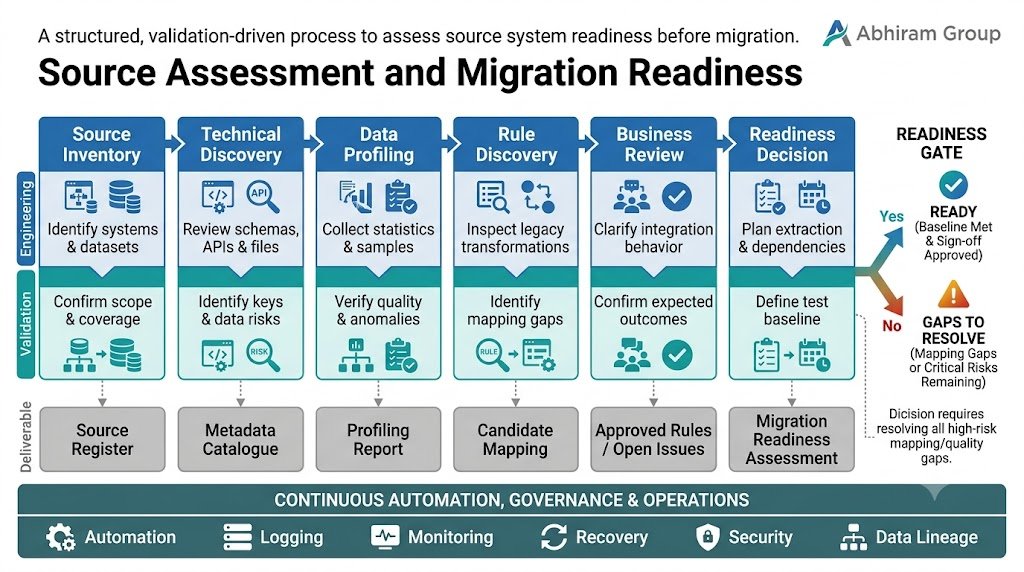
Once the source assessment is complete, the team should review whether each dataset is ready for migration.
Readiness does not mean that every source record must be perfect. It means that the important risks, dependencies and data-handling rules are understood well enough to proceed safely.
The team should confirm that the required source access is available, extraction methods are feasible and business owners have reviewed critical mappings.
Known data-quality issues should be documented with approved handling rules. Unresolved issues that could affect important business information should remain visible and may prevent the affected dataset from moving forward.
The migration plan should also identify historical extraction requirements, incremental processing arrangements, source maintenance windows, expected volumes and downstream dependencies.
For datasets that will be migrated in phases, the team should define how the initial load and subsequent changes will be synchronized.
Engineering must establish the technical extraction approach and recovery options.
QA must establish the baseline data checks, reconciliation rules, test-data needs and acceptance criteria.
The team should also identify who is responsible for resolving source defects, approving business mappings and accepting migration exceptions.
A clear source-readiness assessment reduces the risk of discovering fundamental data problems after the new pipeline has already been developed.
Understanding the source systems is the foundation of reliable data migration.
Once the data sources, extraction methods, dependencies and business rules have been assessed, the next step is to design the cloud architecture that will receive and process the information.
In the next section, we will examine how AWS and Snowflake can support this architecture, beginning with source ingestion into Amazon S3, separate Raw and Curated Zones, transformation processing and the final loading of trusted datasets into Snowflake.
We will also explain where validation, logging, automation and recovery controls fit into the architecture from the beginning.
At the end of the assessment, each dataset should receive a clear readiness decision.
Ready means the required access, extraction method, critical mappings, validation baseline and dependencies have been confirmed.
Ready with Approved Exceptions means the dataset can proceed with known limitations that have been documented, assessed and accepted by the appropriate owners.
Not Ready means unresolved issues could affect the completeness, accuracy, security or usability of the migrated data.
This decision should be supported by evidence rather than a general statement that source analysis has been completed.
Designing the AWS–Snowflake Architecture
Moving data from an existing system to the cloud is only one part of modernization.
A modern data platform must also support different source technologies, increasing data volumes, changing business requirements, secure processing and reliable delivery to downstream applications.
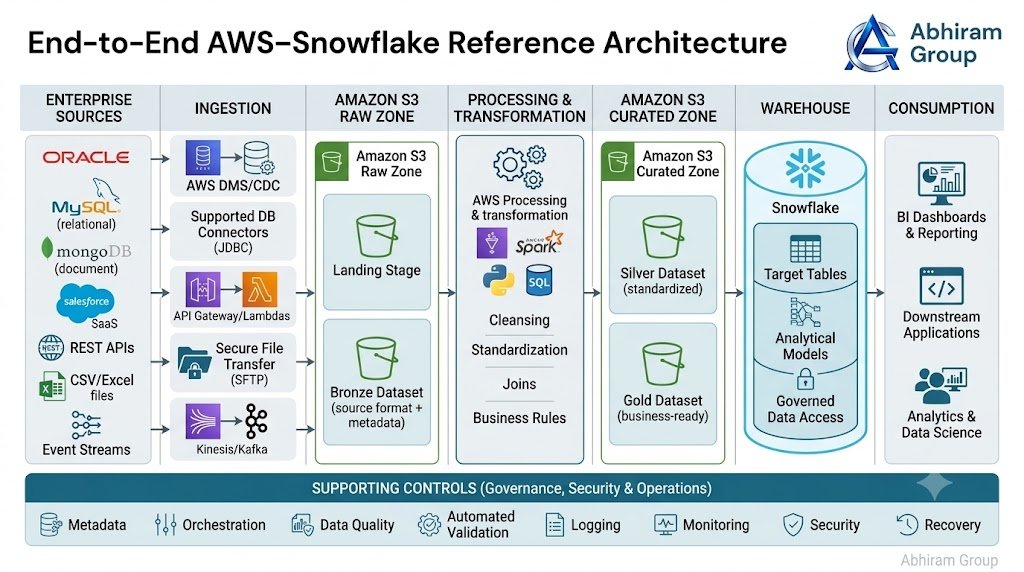
For this reason, the architecture should be designed as a series of connected layers, with each layer having a clear responsibility.
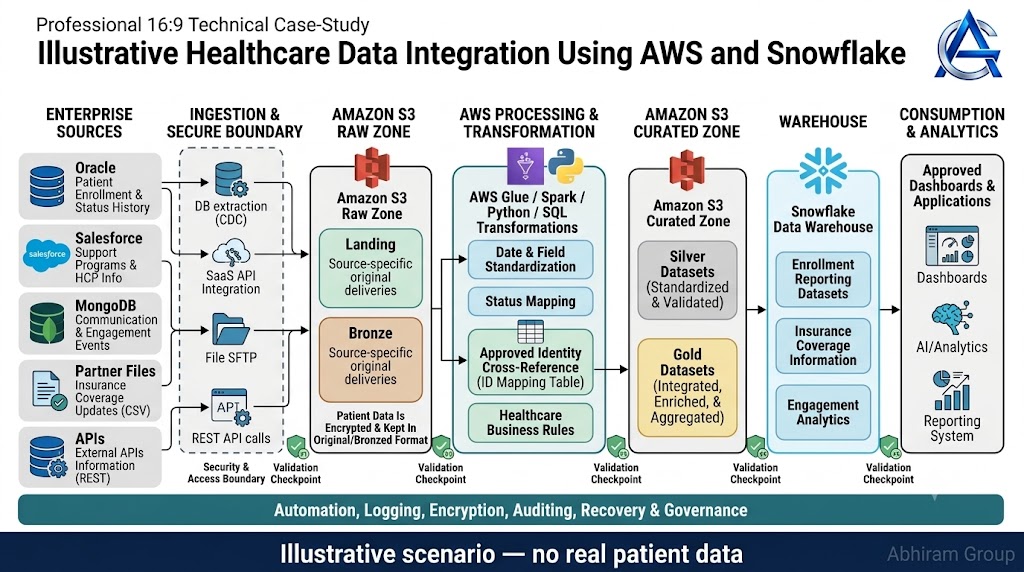
In our reference design, data is extracted from enterprise source systems and received through AWS ingestion services. The original source data is stored in an Amazon S3 Raw Zone before transformation begins.
Processing services then read the raw information, apply approved transformation rules and write the results to a separate Amazon S3 Curated Zone.
The Curated Zone contains standardized and business-ready datasets that can be loaded into Snowflake for further processing, analytics and downstream consumption.
Validation is not limited to the final Snowflake tables. Checks are performed at important points throughout the pipeline so that teams can identify where a difference or failure occurred.
The architecture must also include security, metadata management, logging, monitoring and recovery mechanisms.
The goal is to make the data movement understandable, repeatable and supportable, even when sources change or processing does not complete as expected.
Architecture Layers and Their Responsibilities
Each layer of the data platform should have a defined purpose.
The source layer contains the systems that create or maintain business information. These may include operational databases, CRM applications, external interfaces and partner files.
The ingestion layer is responsible for retrieving information using methods supported by each source. It should capture the required data along with enough metadata to identify when and how the extraction occurred.
The Raw Zone provides a controlled location for preserving source information before business transformations are applied.
The processing layer performs the required standardization, cleansing, filtering, joins and business calculations.
The Curated Zone stores the resulting datasets in forms that can be used consistently by downstream systems.
Snowflake provides a target environment for governed analytical storage, SQL processing and data consumption.
The consumption layer includes dashboards, applications, reports and other systems that depend on the processed information.
These layers should not be treated as completely independent components. Each has dependencies on the previous stages, and a failure in one layer can affect the reliability of later results.
For that reason, the architecture must maintain traceability between the source data, processing rules, pipeline executions and final records.
The design should also support different processing patterns. Some datasets may require frequent incremental updates, while others may be processed through scheduled batches or historical backfills.
Source Connectivity and Data Ingestion
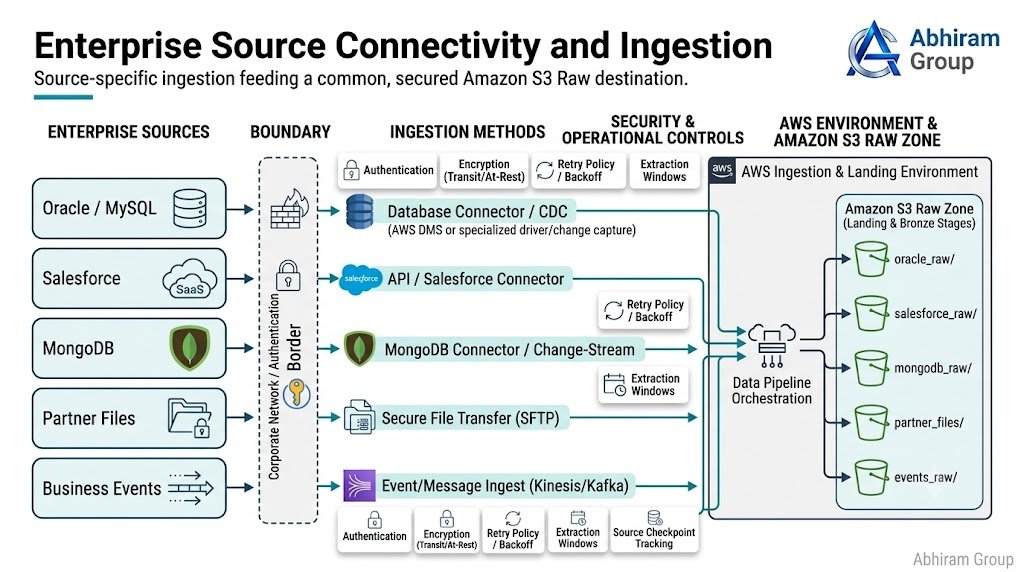
The ingestion layer is the first operational connection between enterprise systems and the cloud data platform.
Its purpose is to retrieve the required information safely and deliver it to the Raw Zone without unintentionally changing its business meaning.
Different sources require different integration methods.
Relational databases may support JDBC-based extraction, database replication or Change Data Capture (CDC).
AWS Database Migration Service (AWS DMS) can support compatible database migration and replication patterns. However, the team must verify that the selected source engine, version and endpoint configuration are supported.
Salesforce and other enterprise applications generally require approved APIs or integration connectors.
MongoDB may require a compatible database connector, export process or supported change-stream approach, depending on the source environment and extraction requirements.
External partners may deliver files through secure transfer mechanisms, while event-driven applications may use streaming or messaging services.
The ingestion process must also consider network connectivity.
A database hosted inside a private corporate network may require an approved private connection, VPN, network routing or another secure integration method before AWS services can access it.
Credentials should be managed securely rather than stored directly in application code or pipeline configuration files.
Practical example: Connecting multiple healthcare systems
Consider a healthcare organization that needs to integrate information from four sources.
An Oracle database contains patient enrollment records. Salesforce contains support-program information. MongoDB contains patient communication events. A partner sends insurance coverage updates through a daily CSV file.
The engineering team must configure a suitable ingestion method for each source.
The Oracle extraction may use a supported database connector or CDC. Salesforce information may be retrieved through an approved API. MongoDB events may be extracted through a compatible connector, while insurance files are received through a secure file-delivery process.
Each source should have its own extraction schedule, connection settings, retry rules and monitoring controls.
Validation must confirm that the expected data has been received from each source, including the required extraction window, files, API pages or change events.
A connection test is only the beginning. The pipeline must also demonstrate that data can be extracted completely, securely and repeatedly.
Amazon S3 Raw Zone: Preserving Source Data
The Amazon S3 Raw Zone is the first persistent storage layer in our reference architecture.
Its primary responsibility is to retain the data received from source systems before business transformations are applied.
Preserving this information is important because the original source extract may be needed for reconciliation, defect investigation, reprocessing or audit purposes.
The Raw Zone should not be treated as a temporary folder where files can be overwritten without tracking.
Each delivery should be identifiable through information such as source name, dataset name, extraction window, batch or run identifier and ingestion timestamp.
Depending on the source and extraction method, the stored information may be CSV, JSON, Parquet, Avro or another suitable format.
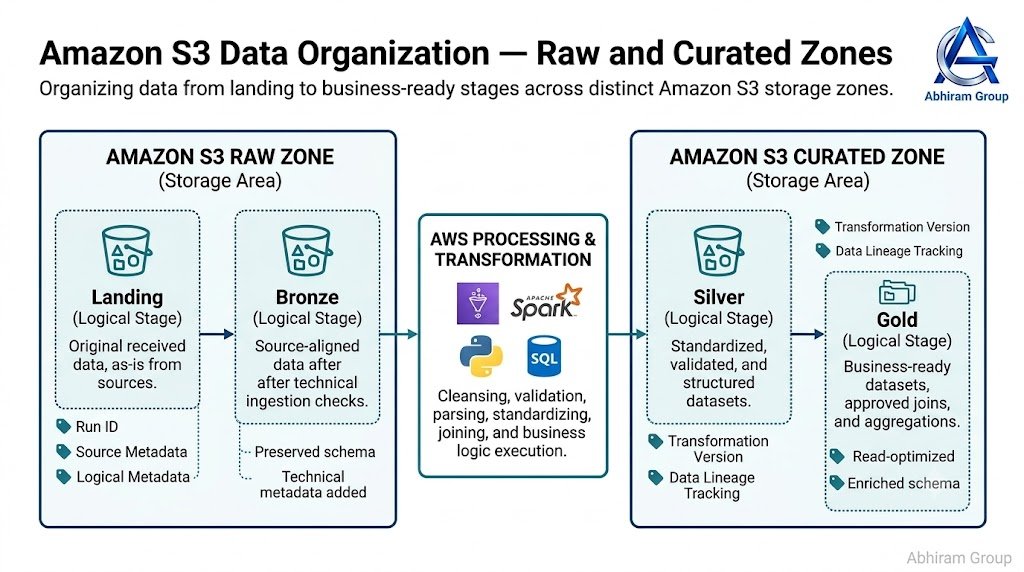
The architecture should also distinguish between the initial landing area and the logical Bronze stage.
The landing area receives the source delivery. Bronze represents the controlled, source-aligned dataset that has passed the required technical ingestion checks while retaining the original business values.
These are logical stages within the Raw Zone. They do not require separate S3 buckets in every implementation.
Practical example: Daily enrollment extraction
Suppose the Oracle enrollment system produces an extract for a specific processing window.
The ingestion process stores the extract in a source-specific S3 path and records the batch identifier, extraction window, received timestamp and control totals.
Before the data moves to the next stage, technical checks verify that the expected files are present, readable and associated with the correct execution.
If the transformation job fails later, the team should be able to identify the original extract and use it for controlled reprocessing.
The design should prevent an accidental overwrite of the original delivery.
Access permissions, encryption and retention policies must be defined according to the organization's security and compliance requirements.
Processing and Transformation: Converting Source Data into Usable Information
Once data has been received and preserved, processing services prepare it for business use.
In an AWS-based architecture, these activities may be implemented using AWS Glue, Apache Spark, Python, SQL or other approved processing technologies.
The technology choice depends on data volume, transformation complexity, operational requirements and the skills available to support the solution.
Common transformation activities include standardizing date formats, converting data types, validating mandatory fields, resolving approved reference values, removing unwanted duplicates and applying business calculations.
More complex processing may combine data from several sources.
For example, enrollment information may need to be connected with communication history and insurance coverage data.
However, records from different systems should not be joined simply because they contain similar-looking identifiers.
The team must use approved business keys, cross-reference tables or identity-resolution rules.
Transformation logic should be documented and version-controlled so that changes can be reviewed, tested and reproduced.
Practical example: Standardizing enrollment dates
Assume the source systems provide dates in different formats.
Oracle provides an enrollment timestamp, an API returns an ISO-formatted date-time string and a partner CSV contains a date in a documented local format.
The processing layer converts these values into an agreed target representation.
If the target requires a calendar date, the conversion must account for the approved time zone and business interpretation.
An invalid or ambiguous date should not be silently converted into a different value.
Depending on the approved handling rules, the affected record may be rejected, quarantined or flagged for review.
Validation must verify that accepted values are converted correctly and that rejected values are traceable to the original source records.
The processing layer should also maintain enough metadata to identify which input records and transformation version produced each output dataset.
Amazon S3 Curated Zone: Silver and Gold Datasets
The Curated Zone is a separate Amazon S3 storage area used to hold processed datasets.
In our reference design, it contains two logical stages: Silver and Gold.
Silver: Standardized and validated data
Silver datasets contain information that has been standardized according to approved technical and data-quality rules.
Examples include consistent data types, normalized date formats, approved identifiers and controlled handling of invalid records.
Silver data should retain enough detail to support further processing and investigation.
Gold: Business-ready data
Gold datasets contain information prepared for a specific business or analytical purpose.
This may include approved joins, calculations, derived fields, business filters and aggregations.
For example, a Gold dataset may combine enrollment, communication and coverage information into a reporting-ready view.
The Gold dataset should not be assumed to contain one row for every source record. Its grain depends on the business requirement.
A patient-level summary may contain one row per patient, while an enrollment-event dataset may contain multiple rows for the same patient.
This difference is important during reconciliation.
Validation must compare the correct business entities, relationships and expected calculations rather than assuming that all layer counts should match.
The Curated Zone should also preserve information about the processing run, transformation version and source lineage.
Separating Raw and Curated storage helps teams protect original extracts while managing standardized and business-ready datasets independently.
Loading Curated Data into Snowflake
Once the required datasets have been prepared, they can be loaded into Snowflake.
Snowflake provides a managed data platform for storing, querying and processing structured and semi-structured information.
In this reference architecture, the main source for Snowflake loading is the S3 Curated Zone.
The loading process must define how data is transferred, how target tables are structured and how repeated or changed records are handled.
For bulk or scheduled loading, Snowflake can load files from an external stage that references an approved S3 location, using suitable file formats and loading commands.
Other supported loading patterns may be considered where near-real-time delivery or different operational requirements apply.
The target may use insert-only loading, replacement of an approved dataset, or an upsert approach such as MERGE.
The correct method depends on the business key, change semantics and whether historical versions must be retained.
Practical example: Updating enrollment information
Assume a curated enrollment dataset contains new enrollments and updates to existing enrollments.
The Snowflake target maintains the current enrollment status for each enrollment ID.
The loading process must insert new enrollments and update existing ones according to approved business rules.
If the same batch is processed again after a failure, the target should not create duplicate enrollments or unintentionally replace newer information with older updates.
This requires a reliable business key, controlled change ordering and an idempotent loading design.
Validation should verify new records, updated records, rejected records and the final target state.
The target should also retain sufficient load metadata to identify the execution and source dataset responsible for the changes.
Downstream Applications, Reporting and Analytics
The purpose of modernization is not simply to populate a cloud data warehouse.
The processed information must support business applications, reports and analytical activities.
Snowflake datasets may be consumed by business intelligence tools, operational reporting systems, analytical applications and approved downstream interfaces.
Different consumers may require different levels of detail.
A dashboard may need monthly aggregated information, while an operational application may require the latest status of a specific business record.
The architecture must define which datasets are authoritative, how frequently they are refreshed and what data-quality conditions must be met before they are made available.
Practical example: Patient support reporting
A reporting application may display the number of active enrollments, pending requests and completed program activities.
These metrics may depend on information received from multiple sources.
If one source feed is delayed, the dashboard may display a technically valid query result that does not represent the expected reporting period.
Validation must therefore check more than whether Snowflake tables contain records.
It should verify the business calculations, reporting period, source completeness and expected freshness of the information.
Where appropriate, downstream datasets should be published only after the required processing and validation controls have completed successfully.
Metadata Management and Pipeline Orchestration
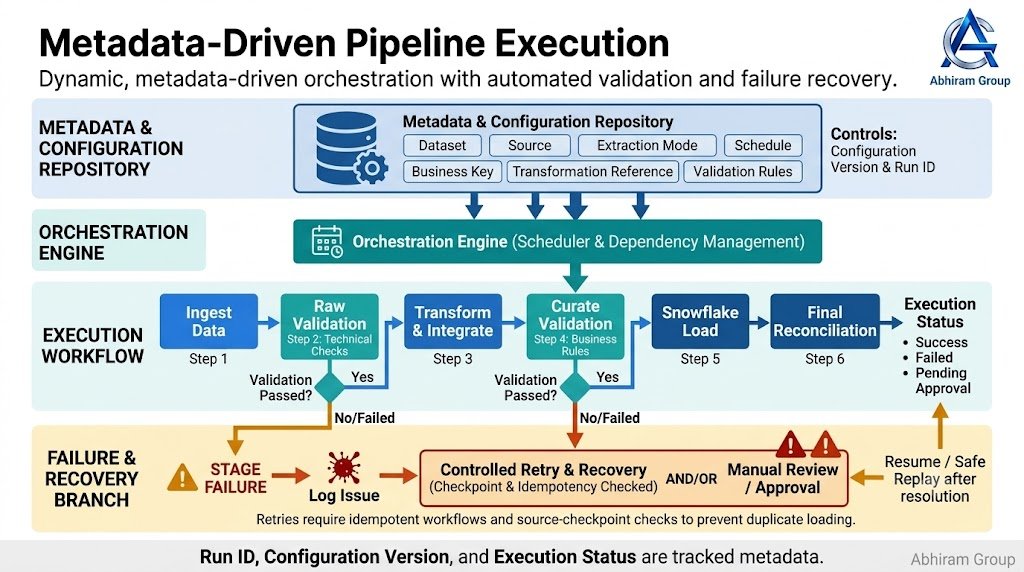
As the number of datasets increases, managing every pipeline through separate hardcoded scripts becomes difficult.
A metadata-driven approach allows common pipeline behavior to be controlled through approved configuration.
For example, metadata may define the source system, dataset name, extraction method, target path, business key, processing schedule, transformation reference and validation rules.
The orchestration layer uses this information to coordinate execution.
Depending on the architecture, orchestration may be implemented using AWS Step Functions, AWS Glue Workflows, Amazon EventBridge, Apache Airflow or another approved scheduling and workflow technology.
The objective is to manage dependencies, execution order, retries, status tracking and operational notifications.
Practical example: Daily enrollment pipeline
Assume the enrollment pipeline is scheduled to run every day.
The workflow first verifies that the required source extraction is available.
It then starts ingestion, checks the received data, executes transformation, validates the curated dataset and loads Snowflake.
After the target load, the workflow performs the required reconciliation checks and records the final execution status.
If an upstream dependency is missing, the workflow should not continue blindly.
If a transformation fails, the orchestration layer should identify the failed step and apply the approved retry or recovery policy.
Metadata-driven execution can reduce repeated implementation work, but it does not eliminate the need to review configuration changes.
Incorrect metadata can affect many datasets, so configuration must be validated, version-controlled and approved.
Security, Privacy and Access Management
Enterprise data platforms frequently process information that must be protected against unauthorized access or disclosure.
Security should therefore be included in the architecture from the beginning rather than added after development.
Connections to source systems should use approved authentication methods and encrypted communication where supported.
Access to AWS services and S3 storage should follow least-privilege principles. Service roles should receive only the permissions required for their tasks.
Sensitive credentials should be managed through an approved secrets-management solution and should not appear in source code, logs or configuration files.
S3 data should be protected through suitable encryption, access policies and network controls.
Snowflake access should be governed through appropriate roles and permissions, with additional protections for sensitive datasets where required.
Practical example: Patient information
In a healthcare integration, enrollment and coverage records may contain personally identifiable information or protected health information.
The architecture should restrict access to these records and avoid exposing sensitive values in application logs, monitoring dashboards or test evidence.
Where appropriate, masking, tokenization or approved de-identification methods can be used for non-production environments and analytical use cases.
Data retention and deletion requirements must also be considered.
The correct controls depend on applicable laws, contracts, organizational policies and the sensitivity of the information.
A successful modernization project must protect the data throughout extraction, storage, processing, validation and downstream consumption.
Logging, Monitoring and Recovery
A data pipeline must remain supportable after it moves into production.
Failures can occur at any stage.
A source connection may time out, an API may stop responding, a file may arrive late, a transformation job may fail or a Snowflake load may complete only part of the intended business process.
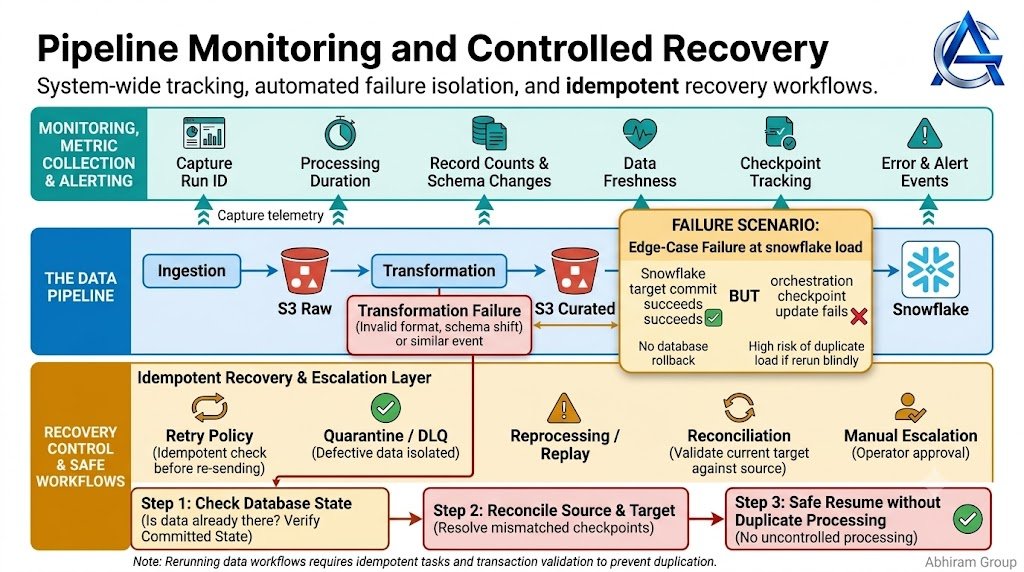
The architecture should record enough information to identify which pipeline ran, what it processed, where it stopped and what happened to the affected data.
Useful operational metadata includes the run ID, dataset, extraction window, source checkpoint, input count, accepted count, rejected count, target load status, processing duration and error category.
Not every pipeline will use the same counters. Counts must be defined according to the transformation and loading behavior.
Monitoring should detect missing deliveries, processing delays, unexpected volume changes, failed jobs and reconciliation differences.
Practical example: Transformation failure
Assume a daily enrollment pipeline receives 10,000 records.
The raw ingestion completes successfully, but the transformation job stops before the curated dataset is fully published.
The recovery process should identify the affected run and determine whether any incomplete output must be removed, isolated or replaced.
The original raw extract should remain available for controlled reprocessing.
The pipeline should not mark the dataset as successfully processed until the required output and validation checks are complete.
A more difficult failure occurs when Snowflake has committed a target update but the orchestration system fails before recording success.
In that situation, a simple rerun could produce incorrect results unless the load is designed to recognize already-applied changes.
The architecture should therefore use appropriate checkpointing, run tracking and idempotent processing controls.
Validation Across the Architecture
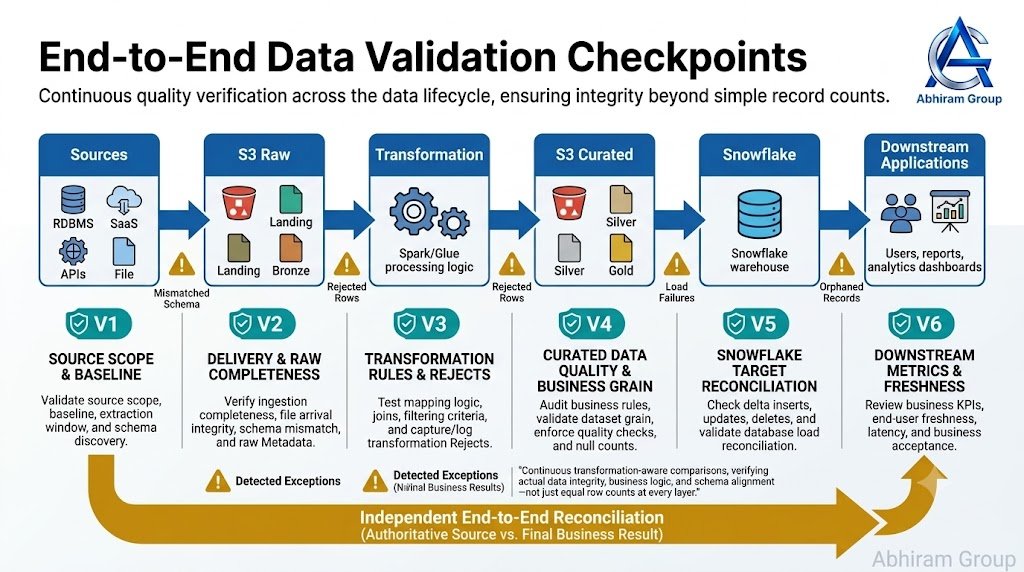
Data validation should be planned alongside the architecture rather than introduced only after development is complete.
Each major processing stage should have checks appropriate to its responsibility.
At ingestion, validation confirms that the required source data was received for the expected extraction window.
In the Raw Zone, checks verify file integrity, required metadata, schema expectations and technical ingestion completeness.
During transformation, validation confirms that the approved cleansing, mapping, filtering, joining and calculation rules have been applied correctly.
In the Curated Zone, checks verify the expected data quality, business relationships and readiness for loading.
After Snowflake loading, validation confirms that the required target changes were applied correctly.
Finally, downstream checks confirm that applications and reports produce the expected business results.
Independent source-to-target reconciliation
Layer-by-layer checks help identify where a problem occurred, but they should not be the only form of validation.
A transformation defect can sometimes produce internally consistent results across several downstream stages.
For this reason, important business outcomes should also be independently reconciled against the authoritative source information and approved transformation rules.
For example, if a Gold dataset contains one row per enrollment, validation should not assume its count must match the number of raw communication events.
Instead, the test should establish the expected enrollment population, apply the approved filtering and relationship rules independently, and compare the expected results with the final target.
Validation should also include negative scenarios, boundary conditions, incremental updates, deleted records, duplicate deliveries and recovery behavior.
Automated checks can make these controls repeatable, but business owners must still approve the meaning of critical rules and the final acceptance criteria.
Detailed reconciliation and automation approaches will be discussed in later
Practical Example: Integrating Healthcare Data Across Multiple Systems
To understand how the architecture works, consider a fictional healthcare organization that needs a consolidated view of patient enrollment and support-program activity.
The information is currently distributed across several systems.
Oracle stores patient enrollment records and enrollment status history.
Salesforce maintains support-program and healthcare professional information.
MongoDB contains patient communication and engagement events.
An external partner provides insurance coverage updates through scheduled files.
Another system provides selected information through APIs.
The organization wants to bring this information together for approved operational reporting and analytics.
Step 1: Ingest the source information
Each source is connected through an appropriate ingestion method.
Oracle records are extracted through a supported database integration approach. Salesforce and API information are retrieved through approved interfaces. MongoDB information is extracted through a compatible connector, and partner files are received through a secure delivery mechanism.
The extracts are stored in source-specific paths in the S3 Raw Zone.
Step 2: Preserve and verify the raw deliveries
Each source delivery is associated with an execution identifier and extraction metadata.
Technical checks confirm that the expected files or records have been received and that the required source information is available for processing.
If a source delivery is incomplete, the affected dataset is held for investigation or controlled recovery.
Step 3: Standardize the information
Processing jobs convert the received data into approved structures.
Date formats, identifiers, status values and other fields are standardized according to documented rules.
Invalid records are handled through the agreed exception process.
Step 4: Integrate related business information
The pipeline uses approved cross-reference information to connect related enrollment, communication and coverage records.
The design must not assume that the patient identifiers used by Oracle, MongoDB and Salesforce are interchangeable.
The target business grain is defined before the datasets are joined.
For example, an enrollment-level dataset may contain one row per enrollment, while communication history may contain multiple events for the same enrollment.
Step 5: Prepare curated datasets
Silver datasets preserve standardized information with the detail required for further processing.
Gold datasets apply the approved business logic needed for reporting and analysis.
These datasets are stored in the separate S3 Curated Zone.
Step 6: Load Snowflake
The required curated datasets are loaded into Snowflake using the selected loading strategy.
The process handles new records and changes to existing records according to the approved business keys and history requirements.
Step 7: Validate the business results
Validation compares the expected source information, approved transformations and final Snowflake results.
It checks record completeness, business relationships, status mappings, calculations, duplicates and downstream reporting behavior.
If a difference is found, the execution metadata and lineage information help identify where the records changed or failed.
Step 8: Publish the information
Once the required controls pass, the approved datasets become available for reporting or downstream consumption.
If a critical source is missing or reconciliation fails, the publication process follows the agreed exception and release policy rather than automatically treating the pipeline as successful.
This example illustrates why modernization requires more than connectivity and data movement. The platform must also preserve source information, apply consistent business rules, validate results and support reliable operations.
Architecture Decisions and Trade-Offs
There is no single architecture that fits every migration project.
The appropriate design depends on the source systems, expected data volumes, processing frequency, security requirements, available skills and downstream business needs.
For example, a small daily file integration may not require the same processing infrastructure as a large database CDC pipeline.
Some datasets may need frequent updates, while others can be processed through scheduled batches.
The team must also decide which transformations belong in AWS and which belong in Snowflake.
Performing every transformation in AWS may increase the amount of processing infrastructure that needs to be managed. Moving every transformation into Snowflake may increase dependency on warehouse processing and change how intermediate datasets are retained.
A balanced design should consider performance, maintainability, operational complexity, data movement and cost.
The use of both Raw and Curated S3 storage provides clear separation between original source deliveries and processed datasets, but it also introduces storage, lifecycle-management and governance responsibilities.
Similarly, adding validation checkpoints improves visibility but may increase execution time if checks are not designed efficiently.
The objective is not to use the maximum number of cloud services.
It is to select the components required to meet business expectations for accuracy, freshness, security, scalability, recovery and cost.
Architecture decisions should be documented so that future teams understand why a particular approach was selected and what assumptions must remain valid.
Architecture Readiness Checklist
Before implementing the AWS–Snowflake architecture, the project team should confirm that the major design decisions have been reviewed.
- Source connectivity: Required source access, supported connectors and network routes are identified.
- Ingestion design: Full-load, incremental, CDC, API and file-processing requirements are documented.
- Raw storage: Source data preservation, metadata, access controls and retention rules are defined.
- Transformation: Business mappings, processing dependencies and exception-handling rules are approved.
- Curated storage: Silver and Gold datasets have defined structures, business grains and quality expectations.
- Snowflake loading: Target schemas, loading methods, business keys and change-handling rules are agreed.
- Validation: Stage-level checks, independent reconciliation and acceptance criteria are defined.
- Orchestration: Schedules, dependencies, checkpoints, retry policies and failure handling are documented.
- Security: Authentication, encryption, sensitive-data handling and access responsibilities are reviewed.
- Monitoring: Execution logs, data freshness, failure alerts and operational ownership are defined.
- Recovery: Reprocessing, duplicate prevention, checkpoint recovery and escalation paths are considered.
- Cost and performance: Expected volumes, processing windows, storage requirements and cost drivers are assessed.
- Business approval: Critical architecture assumptions, source-to-target rules and unresolved risks are reviewed by the appropriate owners.
These checks do not replace detailed design or testing. They provide a common baseline before implementation begins.
The AWS–Snowflake reference architecture provides a structured approach to receiving, preserving, processing and delivering enterprise data.
However, even a well-designed architecture depends on reliable source extraction.
A missed CDC event, incomplete API response, incorrect extraction window or partially received file can affect every downstream stage.
In the next section, we will examine source extraction and ingestion in detail, including connection setup, full and incremental loads, CDC processing, API pagination, file delivery, source checkpoints and the validation controls needed to confirm that the correct information has entered the platform.