
Customer service has changed significantly over the years. A customer may call a contact center, start a chat from a website, send an email, use a mobile application or contact the company through another digital channel. Regardless of the channel, the expectation is usually the same: understand the problem, provide the right information and resolve the issue without making the customer repeat the same details several times. The challenge is that the person handling the interaction may need information from several systems. Customer details may be in CRM. Transactions may be in another application. Product information may be in a knowledge repository. Previous complaints may be in a case-management system. Authentication may be handled separately. An agent may have to move between these systems while continuing the conversation with the customer. AI can help with some of this work. It can understand a customer's request, search approved knowledge, summarize conversations and assist an agent. But connecting an AI model to a contact center does not automatically create a reliable customer-service solution.
From Call Center to Contact Center
Traditional call centers were mainly designed around telephone conversations. A customer called a number, selected options through an IVR, waited in a queue and eventually spoke with an agent. The agent handled the conversation and recorded the outcome. Customer service now works across many channels. A customer may start on a website, continue through chat and later call an agent. They may already have used a mobile application before contacting support. The service team may also need to send updates through email, SMS or application notifications. The challenge is therefore no longer just managing calls. The organization needs to maintain customer context across channels and connect the interaction with the systems where the actual business process takes place.
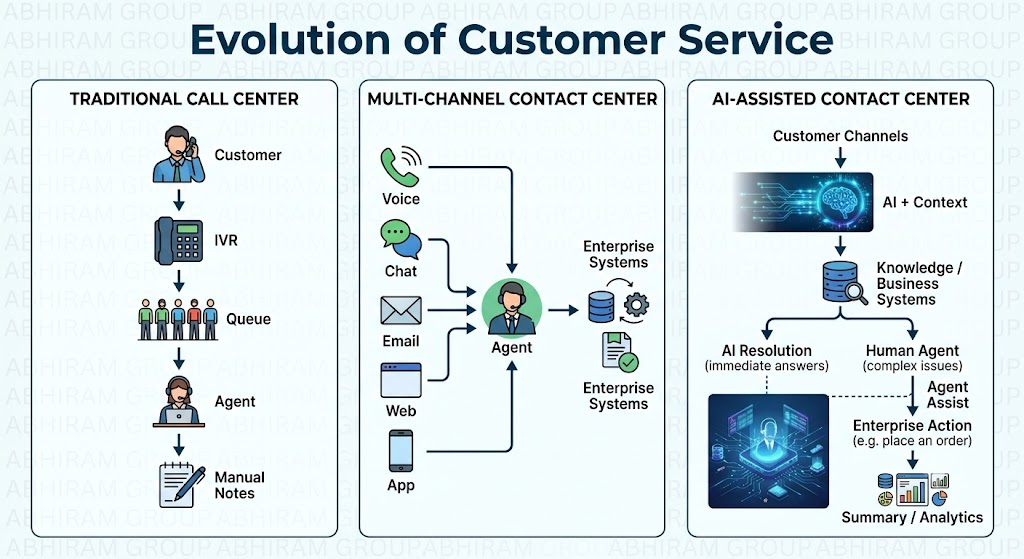
Where Traditional Contact Centers Struggle
Consider a customer calling about a transaction. The agent first needs to understand the issue. The customer may need to complete authentication. The agent then searches for the customer account, reviews the transaction, checks the applicable procedure and decides what should happen next. If another team needs to take over, the information may need to be transferred again. None of these steps is individually unusual. The difficulty comes from performing them together while the customer is waiting. Common problems include customers repeating information after transfers, agents searching several systems during the conversation, inconsistent answers when different knowledge sources are used, manual case notes, long training periods for new agents and limited visibility into recurring customer issues. These are not only call-center problems. They are also data, integration, process and knowledge-management problems.
Where AI Can Help
AI is useful when it removes repetitive work or helps people find information faster. In a contact center, practical uses include: Conversation understanding Identify the likely intent of the customer and capture important information from the conversation. Transcription and summarization Convert voice conversations into text and prepare a summary for review. Knowledge assistance Search approved policies, procedures and product information relevant to the customer's question. Agent Assist Provide the agent with relevant context, knowledge and suggested responses while the conversation is in progress. Interaction analysis Group conversations by intent, complaint type, escalation reason or other patterns that may help operations teams understand recurring problems.
Following One Customer Interaction from Start to Finish
The customer opens web chat and enters: “I bought something yesterday for ₹4,500, but my account shows the charge twice. Can you fix it?” All customer, transaction and policy information used in this example is synthetic. The scenario is used only to explain the solution design. At this point, the system does not know whether the customer was actually charged twice. It only knows what the customer reported.
Step 1: Understand What the Customer Is Asking
Conversational AI can analyze the message and extract useful context. From the customer's sentence, the system may identify: Intent: Possible duplicate debit-card transaction Amount mentioned: ₹4,500 Time reference: Yesterday Customer request: Investigate or correct the transaction Authentication status: Not completed This information helps the workflow understand where to go next. But the AI should not change: “The customer says there are two charges” into: “There are two duplicate charges.” The first statement came from the customer. The second requires verification from the transaction system.
“What the customer reports, what the AI understands and what the system of record confirms are not always the same thing.”
Step 2: Authenticate Before Accessing Customer Data
The customer is asking about their own account. Before the workflow retrieves account-specific information, the customer needs to complete the required authentication process. This responsibility should not sit inside the language model. An identity service should verify the customer, and authorization rules should determine what information and functions are available after authentication. If authentication fails, the AI may still provide permitted general information. It should not expose the customer's transaction history or other protected account information.
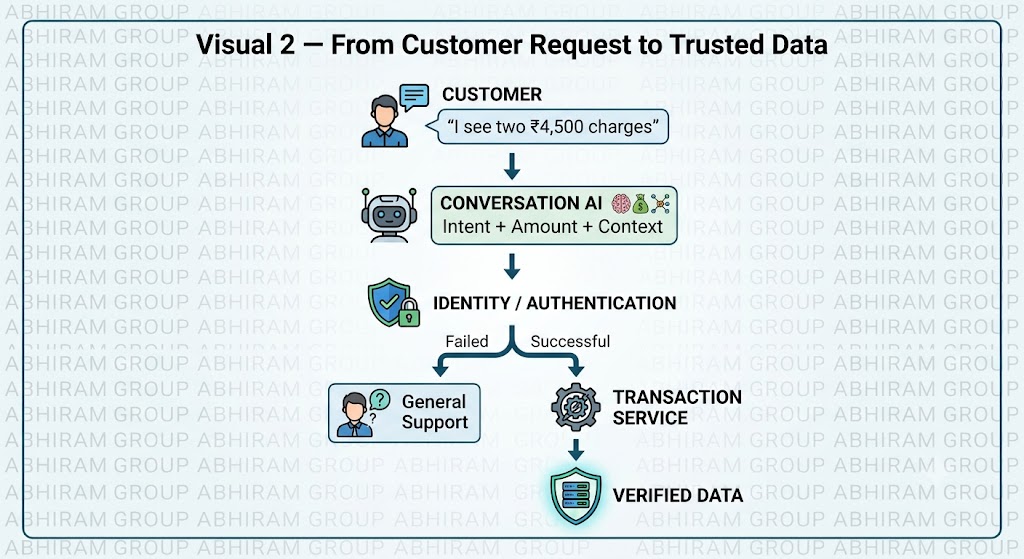
Step 3: Check the System of Record
Assume authentication succeeds. For our synthetic example, the transaction service returns: Transaction 1 Merchant: ABC Electronics Amount: ₹4,500 Status: POSTED Date: 02-Oct-2026 Transaction 2 Merchant: ABC Electronics Amount: ₹4,500 Status: PENDING Date: 02-Oct-2026 The merchant, amount and date appear similar. However, the transaction status is different. The AI should not look at these records and automatically conclude that a duplicate charge has occurred. It needs the organization's approved procedure for handling this situation.
Step 4: Use Approved Enterprise Knowledge
This may include policies, operating procedures, FAQs, product documentation, troubleshooting guides and escalation instructions. An AI assistant can use Retrieval-Augmented Generation, or RAG, to find information relevant to the current interaction. For our example, assume the fictional bank's approved procedure says that when one matching transaction is posted and another remains pending, the situation should not automatically be treated as a confirmed duplicate. Further review may be required. The AI now has three pieces of information: Customer statement — “I was charged twice.” System data — One transaction is posted and another is pending. Approved knowledge — The procedure describing how this condition should be handled.
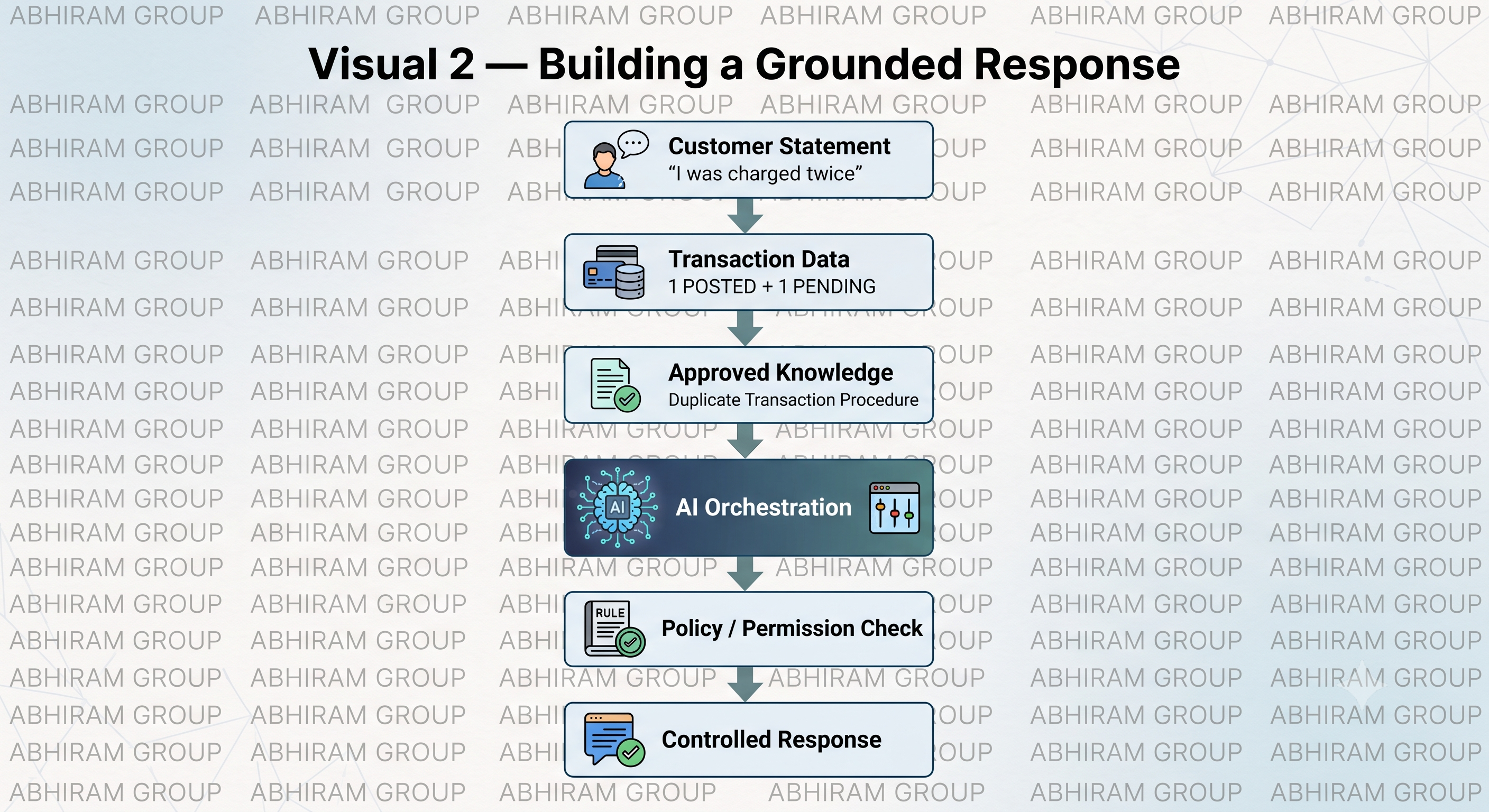
Step 5: Decide What AI Is Allowed to Do
“Can you cancel the second transaction and refund my ₹4,500?” The AI can understand what the customer wants. That does not mean the AI should be allowed to perform the action. The workflow now checks the applicable business rules: Customer authenticated: Yes Transaction information available: Yes Approved procedure available: Yes Account-specific financial action requested: Yes AI authorized to perform the action: No The interaction therefore moves to an authorized human workflow.
Step 6: Transfer the Work, Not Just the Customer
When a customer moves from AI to a human agent, the information already collected should move with them. Otherwise, the customer completes authentication, explains the problem to AI and then has to repeat everything to the agent. For our example, the handoff could include: Intent Possible duplicate debit-card transaction Authentication Completed Customer Statement Customer reports two ₹4,500 transactions for one purchase. Verified Transaction Information ABC Electronics — ₹4,500 — POSTED ABC Electronics — ₹4,500 — PENDING Knowledge Retrieved Approved duplicate-transaction procedure Actions Completed Intent identified Customer authenticated Transaction data retrieved Relevant knowledge retrieved Actions Not Performed No transaction reversed No dispute created No refund promised Reason for Escalation Account-specific financial action requires authorized review.
AI Can Continue as Agent Assist
The role of AI changes after the handoff. Instead of speaking directly to the customer, AI can support the agent. For example, Agent Assist can show the customer intent, relevant transaction information, applicable knowledge, previous conversation and a draft response. The agent can review this information and take the appropriate action through the authorized enterprise system. This reduces the need to search several systems manually while keeping the human responsible for decisions that require human authorization.
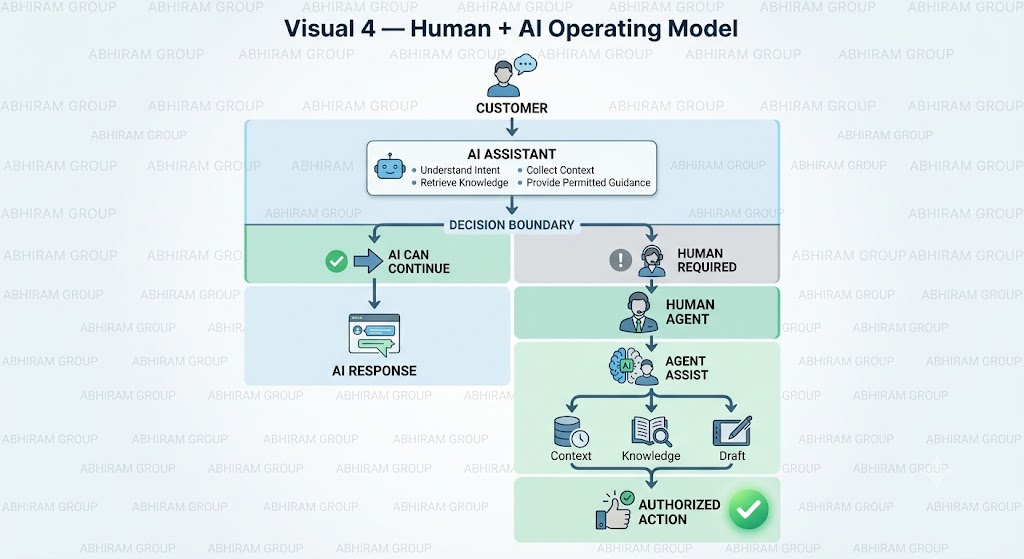
What the Architecture Looks Like Behind the Conversation
A customer sees a chat window or hears a voice assistant. Behind that simple interface, several services may be involved. The channel receives the interaction. Identity services handle authentication. The AI orchestration layer manages the conversation and calls the appropriate services. RAG retrieves approved knowledge. Business rules determine permitted actions. CRM and transaction systems provide customer information. Human agents handle situations that require their involvement.
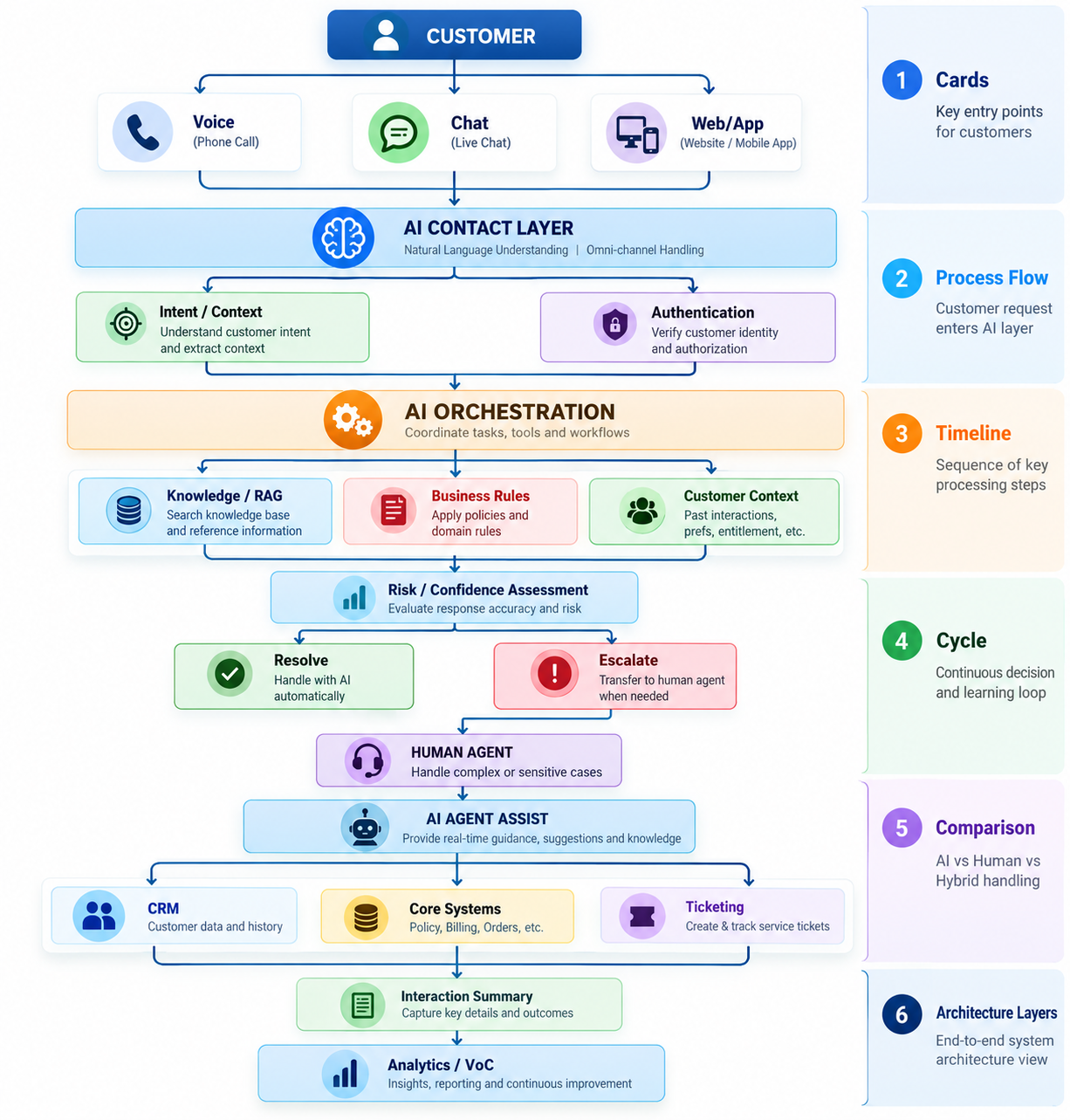
Proof-of-Concept Design: From Customer Conversation to Human Resolution
The purpose of the PoC is not to simulate an entire banking platform. It is to demonstrate the interaction between the important components: customer conversation, intent identification, authentication state, synthetic transaction data, enterprise knowledge, business rules, AI response, human escalation and Agent Assist. All data should remain synthetic. The PoC should also make the boundaries visible. A user should be able to see what information came from the customer, what came from the transaction service, what knowledge was retrieved and why the workflow continued with AI or moved to a human.
Proposed PoC Flow
- 1. Customer enters the duplicate-transaction question.
- 2. AI identifies the likely intent and extracts the amount.
- 3. Workflow checks authentication status.
- 4. Synthetic authentication is completed.
- 5. Transaction API returns one POSTED and one PENDING transaction.
- 6. RAG retrieves the approved fictional procedure.
- 7. AI provides permitted guidance based on the available information.
- 8. Customer requests a financial action.
- 9. Business rules determine that human authorization is required.
- 10. Complete interaction context is passed to Agent Assist.
- 11. Human agent reviews the information and performs the simulated authorized action.
- 12. AI prepares a draft interaction summary for agent review.
A Successful Demo Is Not Evidence of a Production-Ready AI System
The customer asks the expected question, the knowledge base contains the expected document, every API works and the model produces a good response. Production environments are different. Customers provide incomplete information. They change their questions. Enterprise systems become unavailable. Knowledge documents may be outdated. Authentication can fail. The model may misunderstand the request or generate a statement that is not supported by the available information.
Testing therefore has to cover the complete service workflow, not only whether the chatbot produced a readable answer.
Testing Beyond the Happy Path
Authentication failure The customer should not receive protected account information. Missing knowledge The AI should not create a procedure that does not exist. Conflicting knowledge The system should not silently choose between contradictory approved documents. Transaction service unavailable The AI should not claim that it checked the customer's transactions. Customer changes intent The workflow should recognize the new issue without losing important context from the first one. Multiple issues in one conversation The system should identify and preserve each relevant intent. Customer requests a human The interaction should follow the permitted handoff path rather than forcing additional AI conversation. Unsupported financial action The system should prevent AI from performing an action outside its authority. Incorrect AI statement The response should be checked against retrieved knowledge and verified system information. Incomplete handoff Important customer, transaction or conversation context should not disappear during escalation. Incorrect summary The generated summary should be checked against the actual interaction before it becomes part of the customer record. These tests examine the behavior of the complete solution rather than treating model accuracy as the only quality measure.
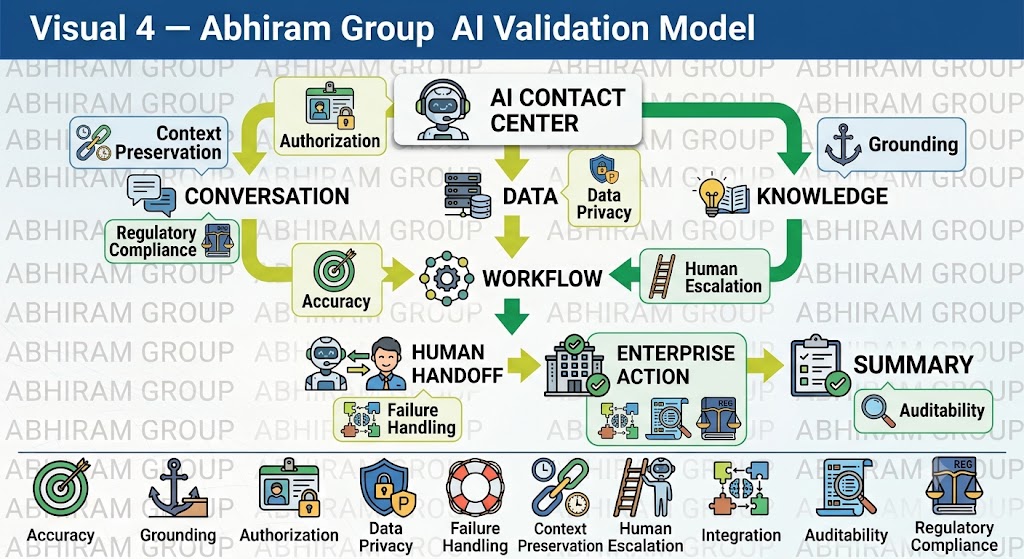
What Happens When the Knowledge Is Wrong?
RAG can help an AI system find enterprise information, but it does not automatically make that information correct. Suppose the knowledge repository contains two versions of the duplicate-transaction procedure. One is current. Another is an older document that was never removed. If both documents are retrieved, the AI now has conflicting instructions. The problem is no longer only the model. The organization needs to know who owns the procedure, which version is active, when it became effective and whether it is approved for customer-facing use. Knowledge governance therefore becomes part of the AI solution.
What Happens When the Transaction System Is Unavailable?
Authentication succeeds, but the transaction API is unavailable. The AI knows what the customer reported, but it cannot verify the account information. It should not say: “I checked your transactions and...” because no transaction data was returned. The workflow should clearly separate customer-provided information from system-verified information and follow the organization's defined failure process. This may involve retrying the service, offering another support option or moving the interaction to an agent.
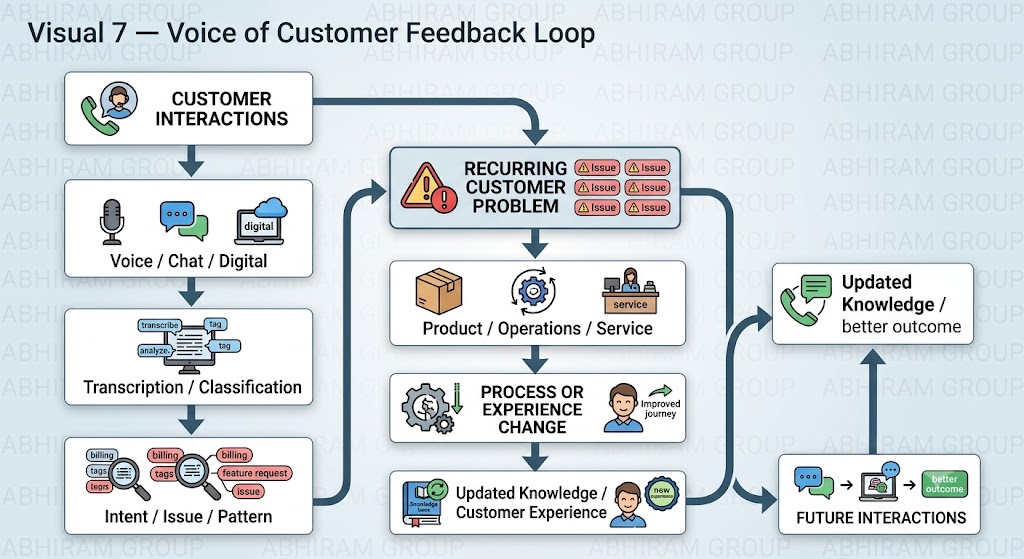
VOICE OF CUSTOMER
One Conversation Solves a Case. Many Conversations Can Reveal a Problem. After the interaction is complete, the conversation can contribute to operational analysis. Assume, for illustration, that a synthetic dataset contains hundreds of customer contacts classified as possible duplicate transactions. Further analysis shows that many of those conversations involve the same pattern: one POSTED transaction + one PENDING transaction. The operations team now has a different question to investigate. Why are customers repeatedly interpreting this pattern as two completed charges? The issue may not be solved only by making the AI answer faster. The organization may need clearer transaction descriptions, better customer education, proactive notifications or changes to the digital banking experience.
ENTERPRISE READINESS
Moving from a PoC to an Enterprise Contact Center A PoC can prove that the basic workflow is technically possible. Production introduces additional responsibilities. The organization needs to decide who owns the knowledge used by AI, how access is controlled, what information is logged, how sensitive data is protected, how model and prompt changes are tested, how integrations are monitored and how incidents are handled. It also needs clear operational ownership. If the AI provides an incorrect response, the issue may come from the model, the prompt, retrieved knowledge, source data, an API, a business rule or the surrounding workflow. Monitoring therefore needs to cover more than model availability. Teams need enough traceability to understand what information was available, what was retrieved, which rule was applied, what response was generated and what action followed. Without that visibility, troubleshooting an AI-enabled workflow becomes difficult.
Building a Contact Center That Uses AI Where It Makes Sense
AI can make customer service easier in several practical ways. It can help understand customer requests, find approved information, summarize conversations and support agents during an interaction. But customer service does not happen inside the language model. The actual service process still depends on identity, customer data, enterprise applications, business rules, knowledge, people and operational controls. A sensible starting point is to select a small number of customer interactions where the process is understood and the required information is available. Define what AI can do, what it cannot do and when responsibility must move to a person. Then test the complete workflow. Test the normal interaction, but also test missing data, failed authentication, unavailable systems, conflicting knowledge, unsupported requests and incomplete handoffs. Measure what happens in practice and improve the process before expanding the level of automation. An AI-powered contact center becomes useful when the technology fits into the service operation—not when the service operation is forced to fit around the AI.